In a stunning upset that has shaken the puzzle-solving community to its tightly interlocking core, acclaimed jigsaw enthusiast Victor Ious was defeated this weekend not by a 10,000-piece double-sided gradient monstrosity — but by the shrink wrap on a newly released board game.
Eyewitnesses say the confrontation began cordially enough, with Ious donning his signature puzzle gloves and making polite observations like, “Ah, standard thermoplastic polymer seal. Classic.” Confidence quickly gave way to concern, however, when he discovered the wrap had no discernible best corner for tearing.
“He tried peeling it like a banana. Then twisting it like a cap. At one point, he asked if anyone had brought a ceremonial dagger,” reported Candace Landry, a fellow game enthusiast who had gathered for the unboxing event. “Eventually, he just started whispering threats.”
After 47 minutes of fruitless struggle, Ious reportedly stared blankly into the middle distance and muttered, “It’s an allegory. The shrink wrap is the puzzle.”
Industry insiders have confirmed that the packaging was designed by Latvian escape room artists under a contractual clause labeled “chaotic neutral.” When asked for comment, the game’s lead designer simply grinned and said, “No one escapes the cellophane.”
Ious is currently recovering in a quiet room, where he is expected to make a full recovery. Those close to the matter have stated he’s already requested training in blister pack resistance.
In the meantime, the board game remains unplayed — and extremely well-preserved.
In a development described by local authorities as “nothing short of a miracle,” the Spiel family concluded a night of board gaming without a single argument, table flip, or eleven-year-old storming off declaring everyone “capitalist pigs.” The secret to their success? A bold, unified decision to not play Monopoly.
“We were halfway through unboxing it when someone suggested Ticket to Ride instead,” said Brett, 42, long-time survivor of Parker Brothers-induced trauma. “There was a brief silence. You could feel generations of suppressed rage in the air. Then my wife said, ‘Yeah, okay,’ and we just… moved on.”
Sociologists are calling the event “unprecedented” and “suspiciously unbelievable.” Dr. Hope Less, from the Institute for Conflict-Free Gaming, has been dispatched to study the family’s dynamics, armed with a clipboard and a laminated chart, titled “Signs of Repressed Monopoly Rage.”
According to Dr. Less, preliminary observations indicate that not playing Monopoly reduced overall stress by 83%, increased snack sharing by 47%, and eliminated the need for emergency medical attention.
The family’s youngest member was reportedly seen actually enjoying himself, a reaction previously thought incompatible with any board game night.
“Refusing to play Monopoly is a radical act of peace,” said Dr. Less, sipping a juice box labeled ‘Research Fuel’. “It’s like refusing to summon Cthulhu, even though he’s already on the table and you’ve got the chant memorized.”
In a final twist, the Spiels ended the night playing Carcassonne, a tile-laying game that resulted in what Brett called a “pleasant disagreement” over a field. “No one screamed. No one tried to burn down a fictional city,” he said, visibly emotional. “I didn’t know board games could end like this.”
At press time, the family was also reviewing Risk‘s future, citing “unresolvable tensions in household alliances” and mom declaring herself Supreme Commander of the Kitchen Table.
In a feat that has baffled architects and concerned neighbors, local board game enthusiast Grant Iose has constructed a 47-foot-tall dice tower in his backyard — a structure now officially taller than his one-story bungalow and, some argue, more structurally sound.
Iose insists it produces the most unbiased dice rolls outside of a particle accelerator. “Standard towers are fine for amateurs and cowards,” he said with a dismissive wave, “but I needed something with actual gravitational authority.”
“It’s not just about fairness, though,” he continued, standing at the base of what neighbors have dubbed Dicezilla. “It’s about ceremony. Gravitas. Making your opponent feel their fate descend like a tiny meteor from the gods.”
The tower, made from reclaimed kallax shelves and “a spiritually significant number of hot glue sticks,” features 65 internal baffles, a spiraling chute, and a wind chime “for dramatic effect”. Iose asserts it improves fairness “by at least 87%”, which he calculated using the time-honored method of shouting, ‘That felt better’ after each roll. He now says he trusts his tower “the way most gamers trust their own understanding of rulebooks — not completely, but enough to keep going anyway.”
Using the ‘Sacred Chute of Chance’ is not without its drawbacks however. Climbing to the top is, “a full-body experience,” Iose admitted, adjusting the utility harness he now wears during game night. The ascent involves a questionable pulley system and what Iose refers to as “the Trust Bridge” — a narrow plank suspended over his compost heap. Players must sign a waiver and pass a brief constitution check before making the climb.
“But it’s worth it,” he insists. “When you hurl your dice downward like the fist of God… gravitas.”
Neighbors have reported mixed feelings, ranging from curiosity to open weeping. “It sounds like a haunted pachinko machine,” said one resident. “We just want to eat dinner in peace.”
City officials remain baffled, with one zoning inspector asking, “Is it residential? Is it recreational? Is it an art piece? We don’t know, but it’s definitely causing a noticeable dip in property values.”
Undeterred, Iose says his next project will be a matching card shuffler that uses “the kind of seriousness usually reserved for quantum physics.”
A quiet evening of boardgaming took a bizarre turn Saturday night when local woman, Ivana Chompsky, was hospitalized after consuming several components of the popular boardgame Food Chain Magnate.
“It started with the pizza tokens,” said her friend, Cody Names, who was seated next to Chompsky. “We thought she was just joking when she popped one in her mouth and said, ‘Tastes like victory.’”
“It didn’t stop there,” said Cody. “Once she started dipping cards in salsa, we knew it had gone too far. I think I heard her mutter something about ‘internalizing the mechanics.’”
“We see this all too often”, say nurses at the local hospital, “and it’s getting worse.” It’s true. Boardgame ingestion has gone up 170% in the last year alone, according to authorities. As boardgame artwork has increased in visual appeal, more players are curious if the games themselves have also increased in deliciousness.
“People just can’t resist,” said Nurse Joy Harrison, head of the hospital’s new Board Game Ingestion Unit. “These games are practically begging to be eaten. You’ve got pizza tokens, burger meeples, and even soda bottle-shaped score trackers. It’s a recipe for disaster – and indigestion.”
Thankfully, Chompsky is in stable condition after an emergency operation to remove what doctors described as “a surprisingly well-organized supply chain.”
Chaos erupted at a local board game group yesterday as the question of what to play devolved into a recursive nightmare of indecision.
The trouble began when each member lobbied hard for their own choices. “I thought Twilight Imperium would be an easy ‘yes’,” said Dell Ushinal, “since it’s such a snappy game.” The other members disagreed. Faced with an impasse, the group proposed playing a short game to decide who got to pick the main event. However, this solution only made things worse, with each member now being inflexible on the new proposed options.
As the clock struck 11:00 PM, the group, still not decided on a game, had at least formed into two groups: the “Uno Loyalists” and the “Anything But That Crew”. However, those alliances began to crumble when veteran member of the group, Candice Landry, proposed Rock Paper Scissors to simplify matters.
By midnight, disagreements had formed into a meta-debate as the group argued whether deciding what to play could itself be considered the evening’s game.
Candice, later clutching a pillow on the couch, reportedly muttered, “I just wanted one game, just one pretty little game, that’s all…”
Ultimately, the night ended with a unanimous decision to “just play Uno next time.” But not before a final heated discussion over whether Uno was truly a board game or simply a card game.
In what can only be described as a tabletop travesty, local board game veteran and self-proclaimed “Master Strategist” Hugh Briss was utterly annihilated during a game of Terraforming Mars by first-time player, Ima Unsher. The defeat has sent shockwaves through the local board gaming community and prompted experts to reexamine the mysterious phenomenon known as Beginner’s Luck.
“How is this possible?” Briss lamented, still clutching a stack of unused project cards. “I’ve played this game 127 times. She kept calling the oceans ‘blue hexagons,’ but somehow managed to score 87 points in milestones alone. Milestones!”
According to eyewitnesses, Unsher began the game by mistakenly placing her first tile on someone else’s board. Despite this shaky start, she unleashed an unstoppable cascade of events leading straight to her victory.
Fellow players described the scene as “equal parts awe-inspiring and soul-crushing.” By the mid-game, Unsher’s playstyle, a chaotic blend of instinct and apparent misunderstanding, had begun to defy all conventional strategies.
Experts have since weighed in on the debacle, with some positing that Beginner’s Luck is a cosmic force designed to humble veteran gamers. Briss, however, remains unconvinced. “Beginner’s Luck? No, this was sabotage. She drew those Jovian cards on purpose just to mock me.”
Unsher, who now plans to “try that castle game with the angry farmers”, has been hailed as a rising star in the local gaming scene. Her victory has sparked a wave of imitators, with new players declaring their allegiance to “Team Blue Hex.”
As for Briss, he’s vowed to regain his honor in the rematch. “I’ve already memorized the card distribution,” he declared, “and I’ll be drafting with precision this time.”
Unsher, when asked about the challenge, responded with a cheerful shrug. “I don’t really care who wins. I just like putting the little forests together. They’re so cute.”
It’s a difficult question to answer for a number of reasons, and not just because of limitations in the data (which we’ll cover). I think the main reason it’s difficult is that each Kickstarter campaign is so unique. The preparation required can differ so much from project to project.
Conventional wisdom rightly points out the best answer to this question, which is “Launch whenever you’re ready.” This hearkens back to the biggest factor that affects your chances of success. There are no substitutes for proper preparation. Launching before you’re ready just so you don’t miss out on “the perfect month” is like trading a dollar for a dime – it’s just never a good idea.
But let’s say you know what it will take to prepare and now you’re just trying to plan things out. Should you plan to launch in August, or would it be worth it to wait a few weeks and launch in September? That’s what we’ll attempt to answer here.
Before We Start
I mentioned that this is a difficult question to answer because each campaign has unique preparation needs, but it’s also difficult because of some limitations in the data. As weird as it may seem, figuring out what month is the best month to launch might just be the most difficult question we’ve tackled in the entire Kickstats series! So here are some things we need to keep in mind as we analyze the data.
Data Timeframe
I’ve only been collecting Kickstarter data since January of 2020. Even though that means I have over 50,000 campaigns, they only cover about 18 months. That means that – right now – July through December only show up for 1 year. A lot of lurking variables can affect a month if it’s only coming from a single year. I’m talking about things like the economy of that year, the number of weekends a given month has, or where holidays land. Even the weather could be a factor if a particular month is much nicer or much gloomier than usual. And that’s not even mentioning COVID, which is obviously a huge factor.
Most likely, a lot of these factors will end up balancing each other out, more or less, but since we only have 18 months, we just don’t know.
Amount of Data
You might think that 50,000+ campaigns would be more than enough to analyze in any way you wanted, but as it turns out, subsets start getting pretty small once you start slicing and dicing on multiple factors.
For instance, during my analysis, I saw that the day of the week, the percentage of first-time creators, the beginning vs end of the month, the funding goal, and certain Kickstarter categories all were potential confounding variables. I’d love to account for all of those, but do you know how many first-time tabletop creators launched a campaign with a goal below the median on the last Monday in January? Five. That’s right – five. That’s just not a big enough number to analyze with confidence.
So, what that means is that I’ve had to choose only the variables that I think might have the biggest effect. From there, we’ll just have to keep these caveats in mind as we attempt to interpret the results.
Analysis
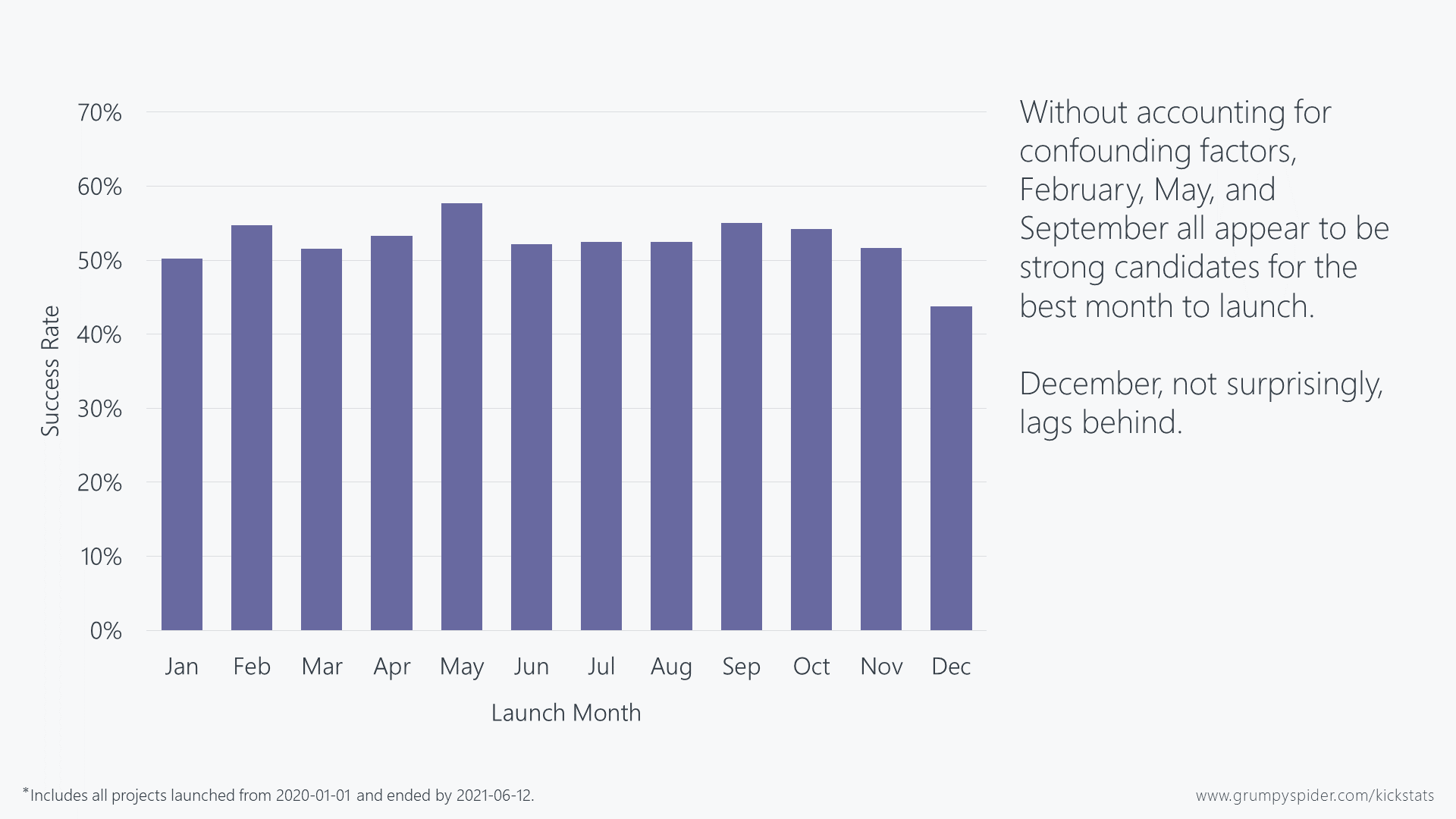
Now that we’re aware of the caveats and are making sure to keep them in mind, let’s start the analysis! As usual, let’s graph the raw numbers.
So it looks like most months are roughly on par with each other. February, May, and September do appear to be just a bit better than the others, but not by much. December, on the other, is quite a bit lower than the other months. I don’t think that comes as much of a surprise, but I do wonder how much of this is because of lurking variables.
Day of the week
We’ve already shown that what day of the week you launch can make a difference. So, it seems obvious that that could be affecting things here. I mean, if Sunday is the worst day to launch, and December has more Sundays than any other month, that could certainly make December look worse than it really is, right? Now, the number of Sundays a month has changes from year to year, but remember, we only have a year and a half’s worth of months right now, so we’ll need to adjust for that.
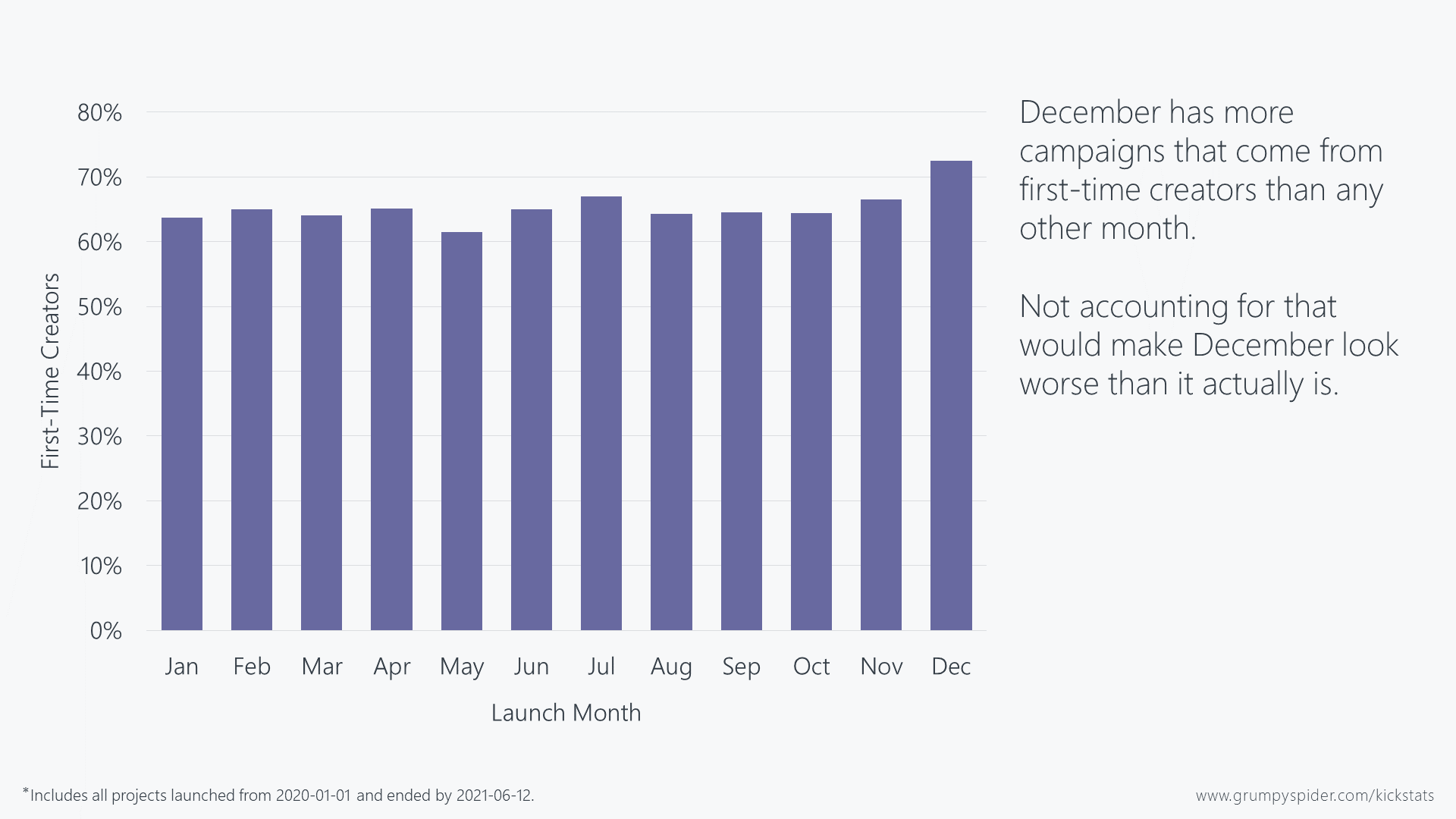
Most months have roughly the same proportion of first-time creators as any other. December, however, has substantially more.
It’s hard to say for sure why, but I’d guess it’s because first-time creators are less likely than their veteran counterparts to come across the conventional advice to avoid December. So, comparatively, it has more.
Tabletop game campaigns
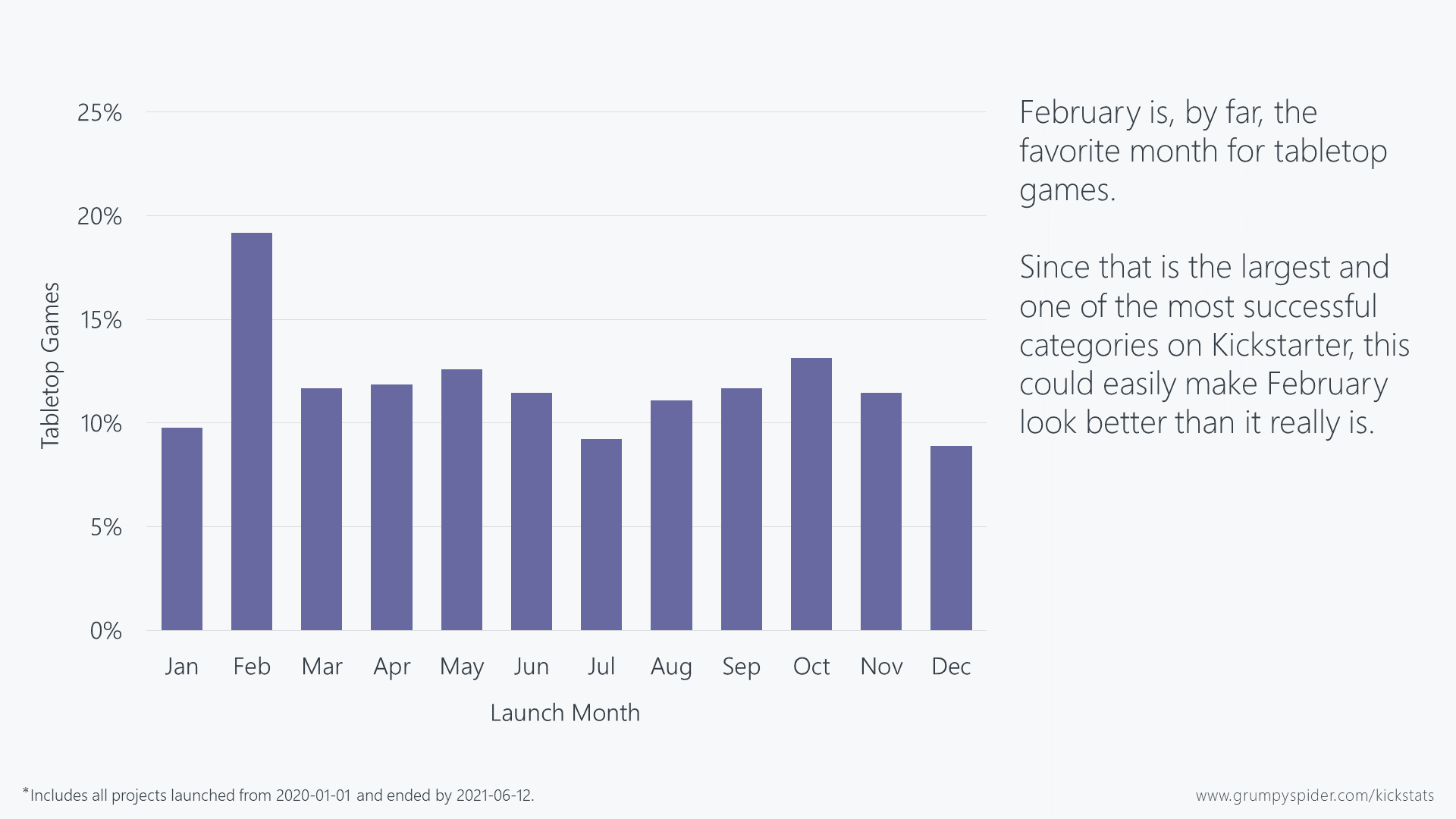
Tabletop games are also another common confounding factor that we’ve recently been trying to account for, since it’s the largest and among the most successful categories on Kickstarter. It could easily influence the outcome if tabletop campaigns aren’t evenly distributed among all months.
Now here’s something that took me by surprise! For some reason, tabletop games seem to love February. Nearly one-fifth of all campaigns that launch in February are tabletop games; more than twice that of July and December! We’ll definitely need to adjust things there as well.
Other factors
Like I mentioned earlier, there are a number of other factors that make strong candidates for confounding variables, but we just don’t have the data we need to include everything. What I’ve attempted to do with the three that I chose was account for what seemed to be the biggest factors. Until we have more data, that’s all we can do.
Results
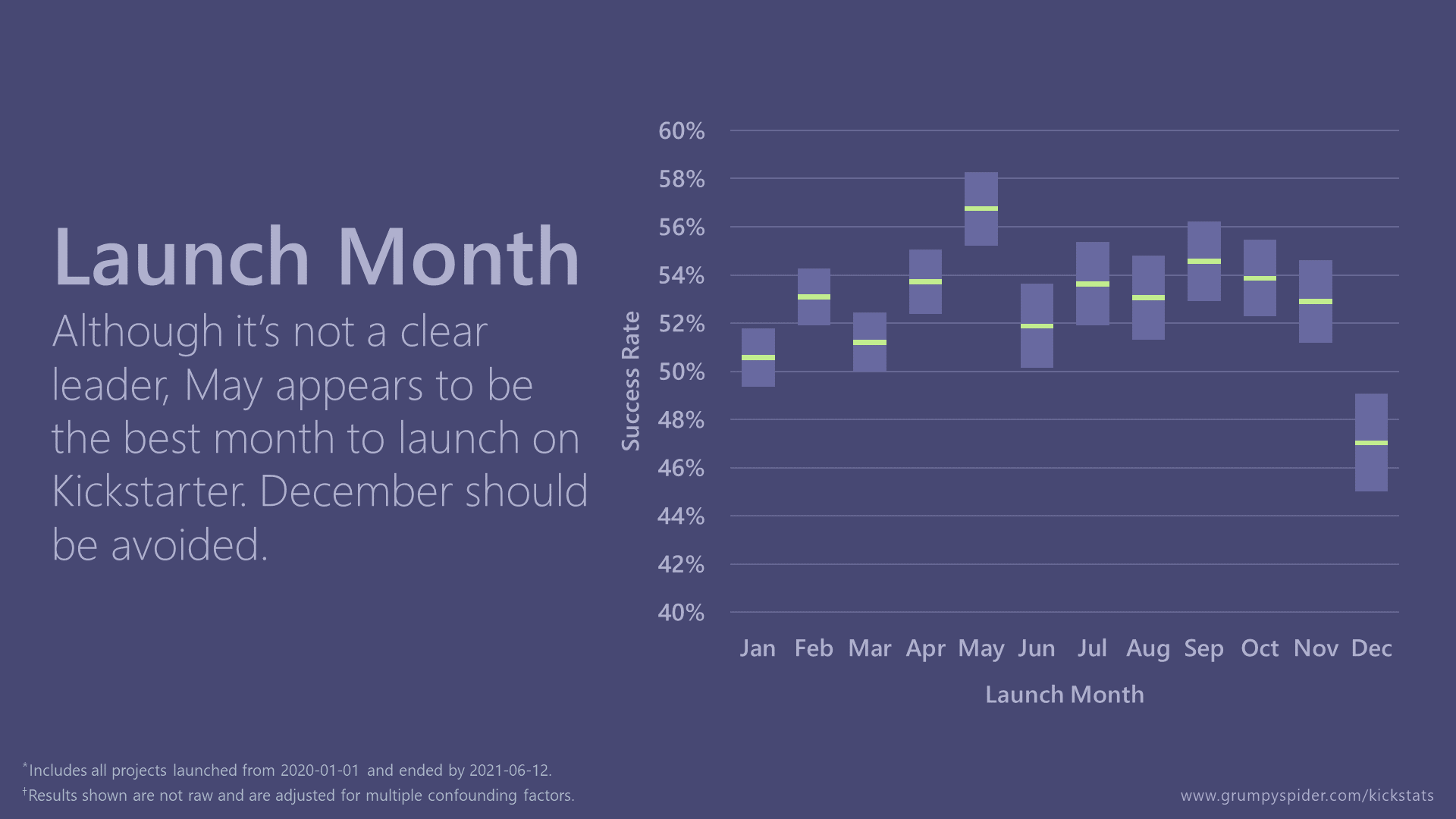
Before we get into interpretation, I want you to notice the range of the vertical axis. Normally, I like to start that axis at zero, but the results are so closely packed that I needed to adjust it so we could see the detail. So keep in mind that what seems like a huge difference is really only a few percentage points at most.
But without further ado, here are the tentative results for best month to launch on Kickstarter!
Well, no earth-shattering changes, but there are a few things we can glean.
First, it looks like February’s spot as 2nd place was largely due to tabletop games liking that month so much. Once you account for that, it falls right to the middle of the pack.
Second, notice the light shaded region for each month. That represents the confidence we have in a given month’s value. The only way we can say with confidence that one month is better/worse than another is if their shaded regions do not overlap at all. As you can see, May has the best success rate, but its shaded region overlaps with September, July, and October. So, we can’t say for sure that May actually is the best. Likewise, we see that June is one of the lower months, but its confidence interval overlaps almost every other month, so we really don’t know where it lands.
One thing we can say with confidence, though, is that December does indeed seem to be a bad month for launching Kickstarter campaigns. Again, there are quite a few factors that we can’t account for yet, so this is all still tentative, but December seems far enough down that I’m fairly confident in the results.
What do you think?
Did these results surprise you? Is there anything you think I should account for as we get more data? Let me know in the comments!
Many people think the time you launch your Kickstarter campaign should focus around America’s Eastern Time Zone. What that means is that they usually recommend launching around 12:00 pm EST. I think catering to that time zone makes sense, since the majority of Kickstarter backers come from the US, and the majority of the US lives in that time zone, or one hour off from that.
The main question I have, however, is: “Why noon?”
Well, the thought is that it hits both coasts of the US at optimal times. For the West Coast, the project launches just as they’re getting up or starting work. For the East Coast, it launches right at the beginning of their lunch breaks. Either way, your project will hopefully be right at the top of the “Recently Launched” section when they view Kickstarter.
I think it’s worth considering alternative times, however. I’ve known quite a few people who go to work early so they can start the day slowly: drink some coffee, answer emails, browse the internet, etc. They don’t really start getting into their work until a little later in the morning, and then they do more of a “working lunch”. If you launched at noon, they might completely miss you!
And what about the people that don’t work your standard desk job? Many of them start and end work later in the day. Their peak time might be noon, but maybe not, it’s hard to say.
Then, of course, there’s international creators, which are an entirely different story. A large chunk of your early backers will be friends and family, and typically that means people in your own time zone. So for international creators, maybe it would be better to cater the launch to your own time zone rather than to the US? Or maybe it doesn’t really matter either way.
Perhaps the data can help us figure out an answer.
Analysis
As always, let’s first look at the raw numbers.
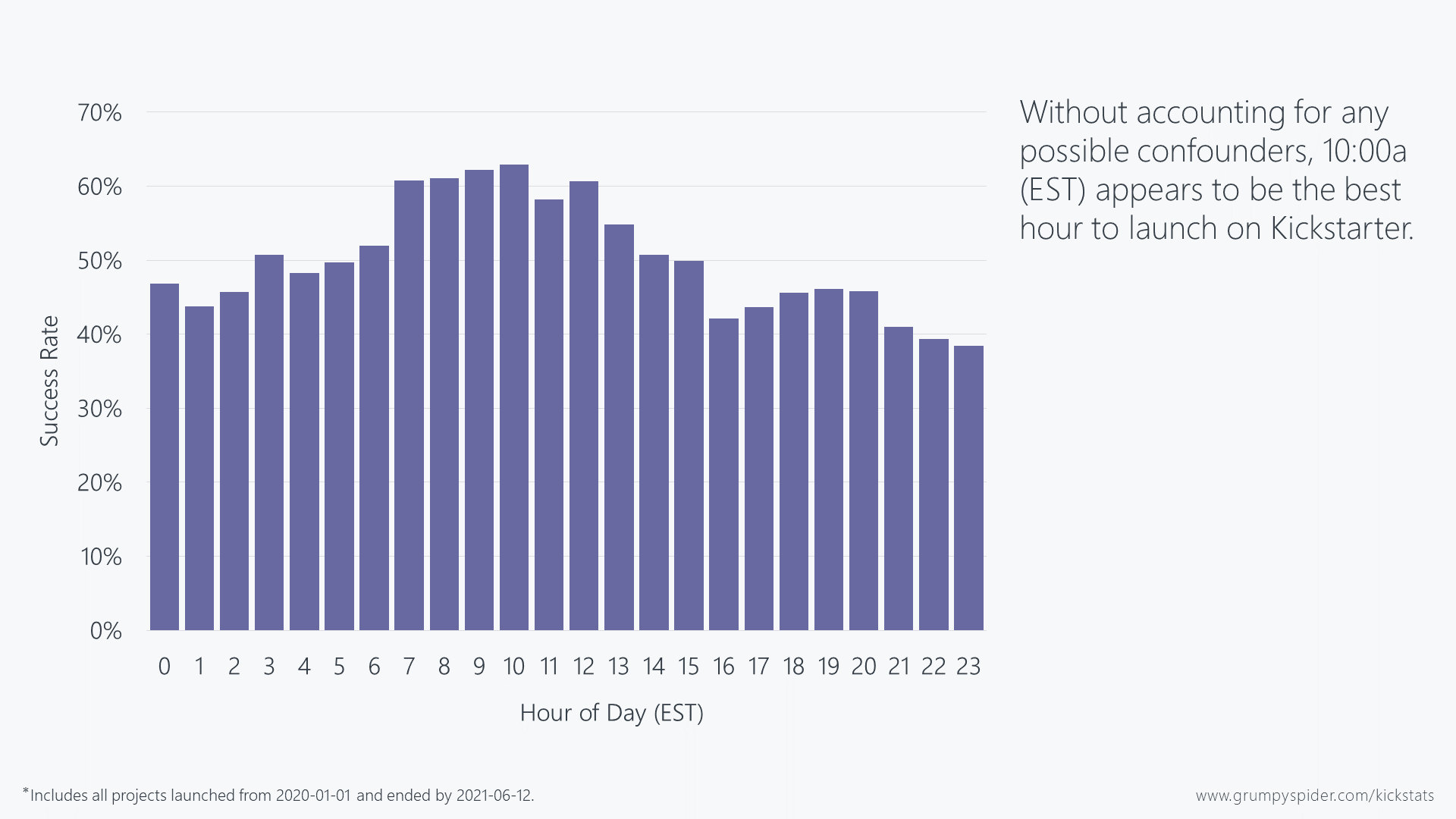
According to the raw numbers, 10:00 – not noon – is the best time to launch on Kickstarter. Of course, by now we should all know that raw numbers are often misleading. So let’s take a look at some possible confounding variables.
Lurking Variables
Guaranteed Successes
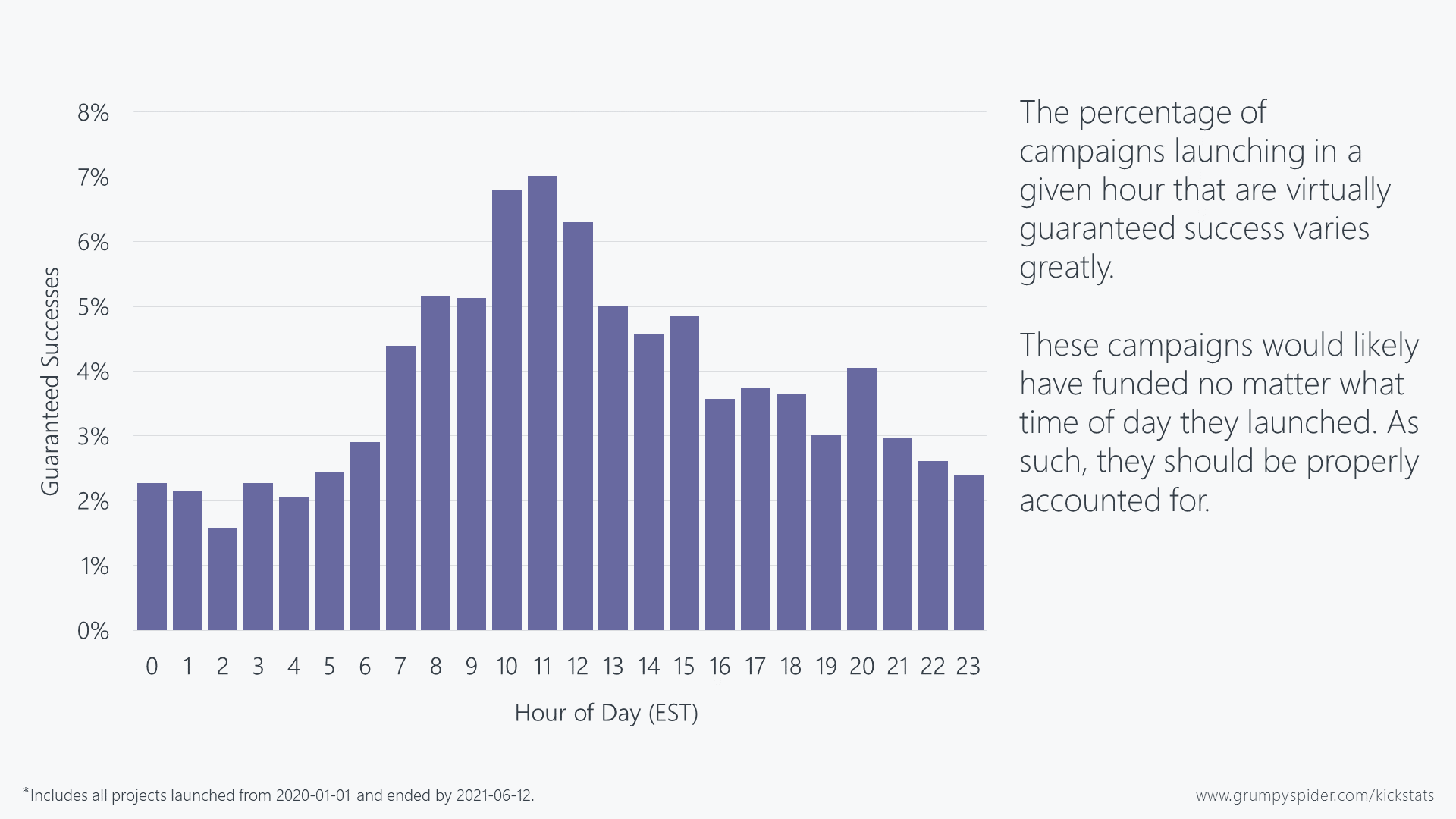
Much like with the best day to launch, mega campaigns seem to love launching at 11:00 am, give or take an hour. The trouble is that those campaigns could launch at 2:00 am and still fund within minutes! The fact that they favor the late morning so much only makes that time look better than it actually is. So we’ll definitely need to account for that.
Guaranteed Failures
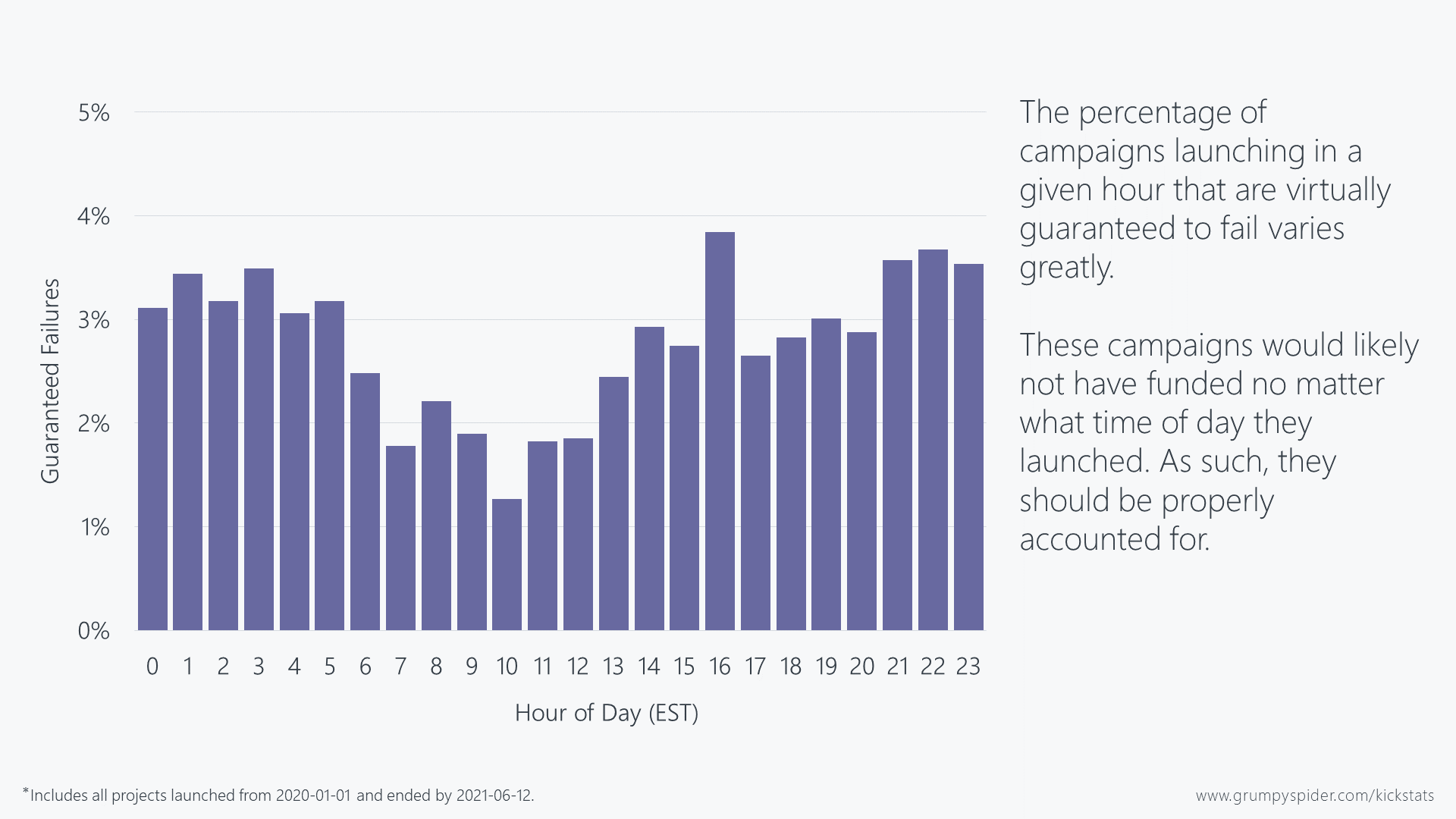
Late morning also seems to have a lower number of Kickstarter campaigns that are virtually guaranteed to fail. Since these campaigns would likely have failed to fund no matter what time of day they launched, we should account for them as well.
In case you’re thinking that late morning has fewer guaranteed failures precisely because it’s a better time to launch, my response is that you might be right. However, I personally believe it’s because creators that do their research tend to launch around 11:00 (due to heeding conventional wisdom), which pushes down the number of poorly-researched campaigns relative to the whole. So it’s not as much that there are fewer low-end campaigns, but that there are more decent campaigns which are crowding that time of day.
I could be wrong, but that’s my thoughts on it, and I think it’s a reasonable enough view to try adjusting for it.
First-Time Creators
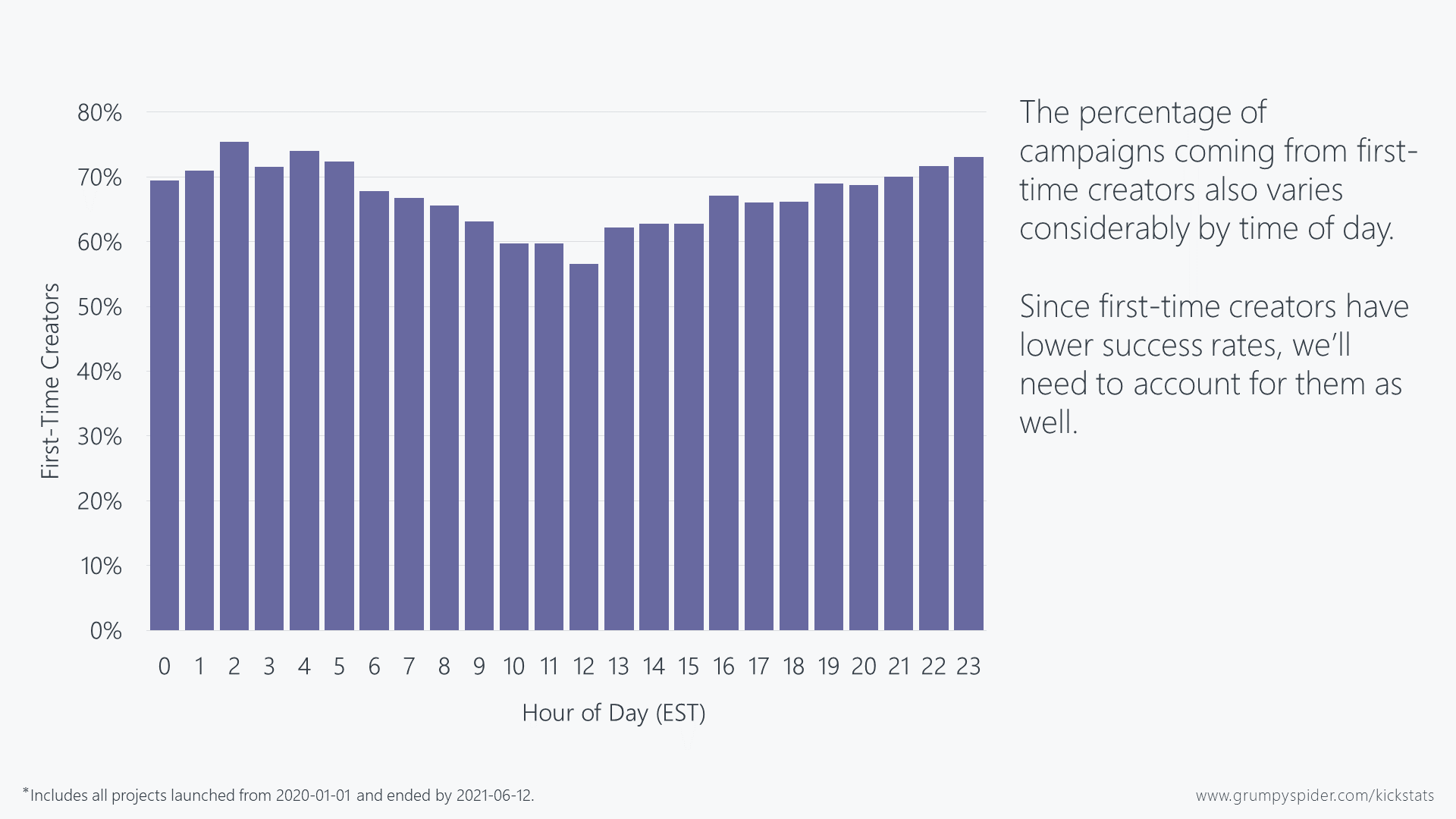
Another common variable we account for is percentage of first-time creators. Since first-timers have lower success rates than their veteran counterparts, it makes sense that we’d want to see if they cluster around any particular time of day.
And it looks like mid-day campaigns tend to have fewer first-time creators than Kickstarter campaigns that launch at other times of the day. I’m not exactly sure why that would be, but we should account for it either way.
Tabletop Game Campaigns
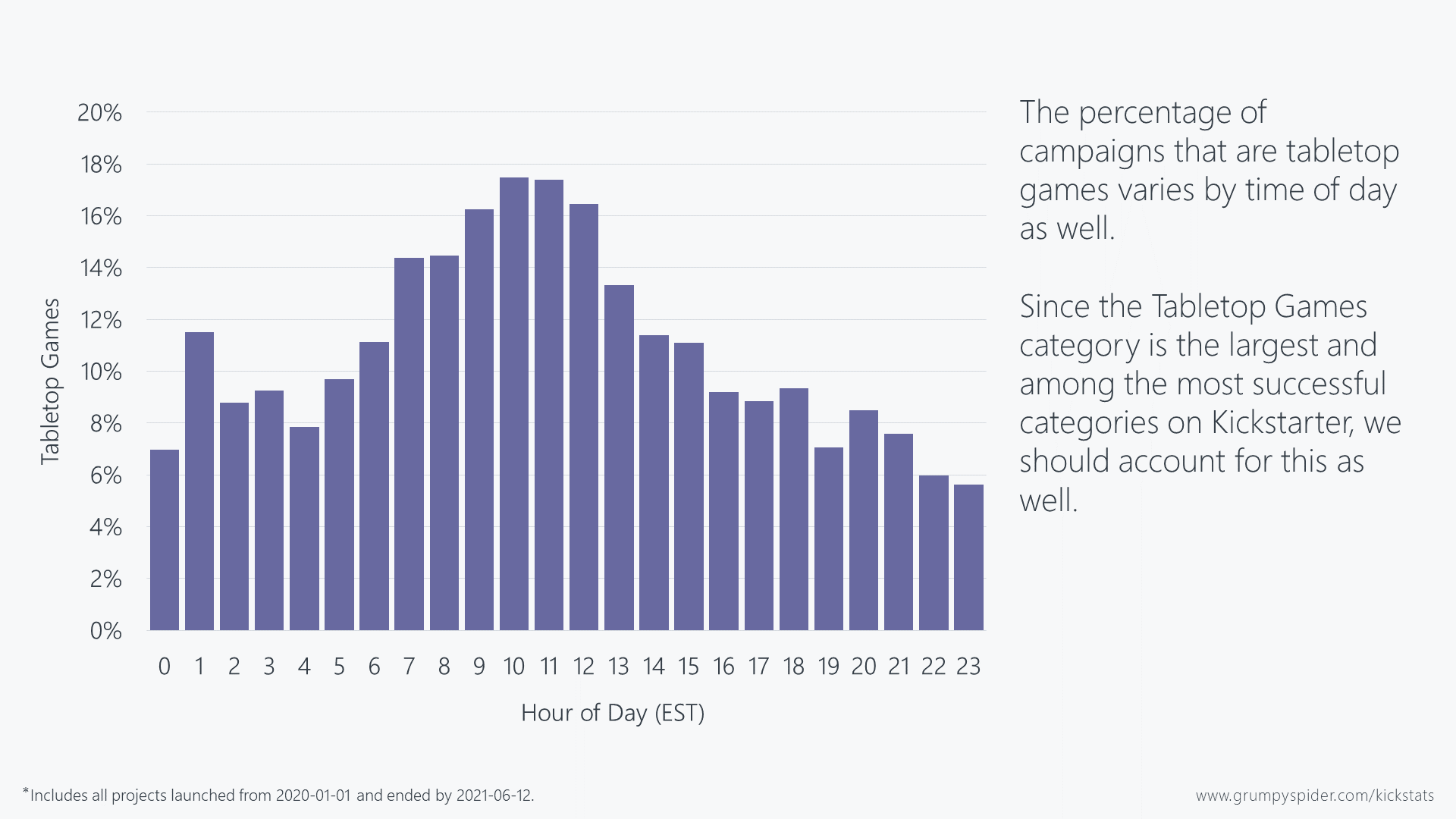
As we’ve mentioned several times before, success rates vary widely between categories. Unfortunately, there are just too many campaigns to be able to account for all of them. One that we can account for, however, is Tabletop Games. Since the Tabletop Games category is the largest and among the most successful categories on Kickstarter, it would be wise to see if they favor any particular time of day as well.
Tabletop Games also seem to favor late-morning launches, although there are also a decent amount launching early morning as well. Either way, the difference between morning and evening is more than enough to suggest that we should account for this too.
US-Based Campaigns
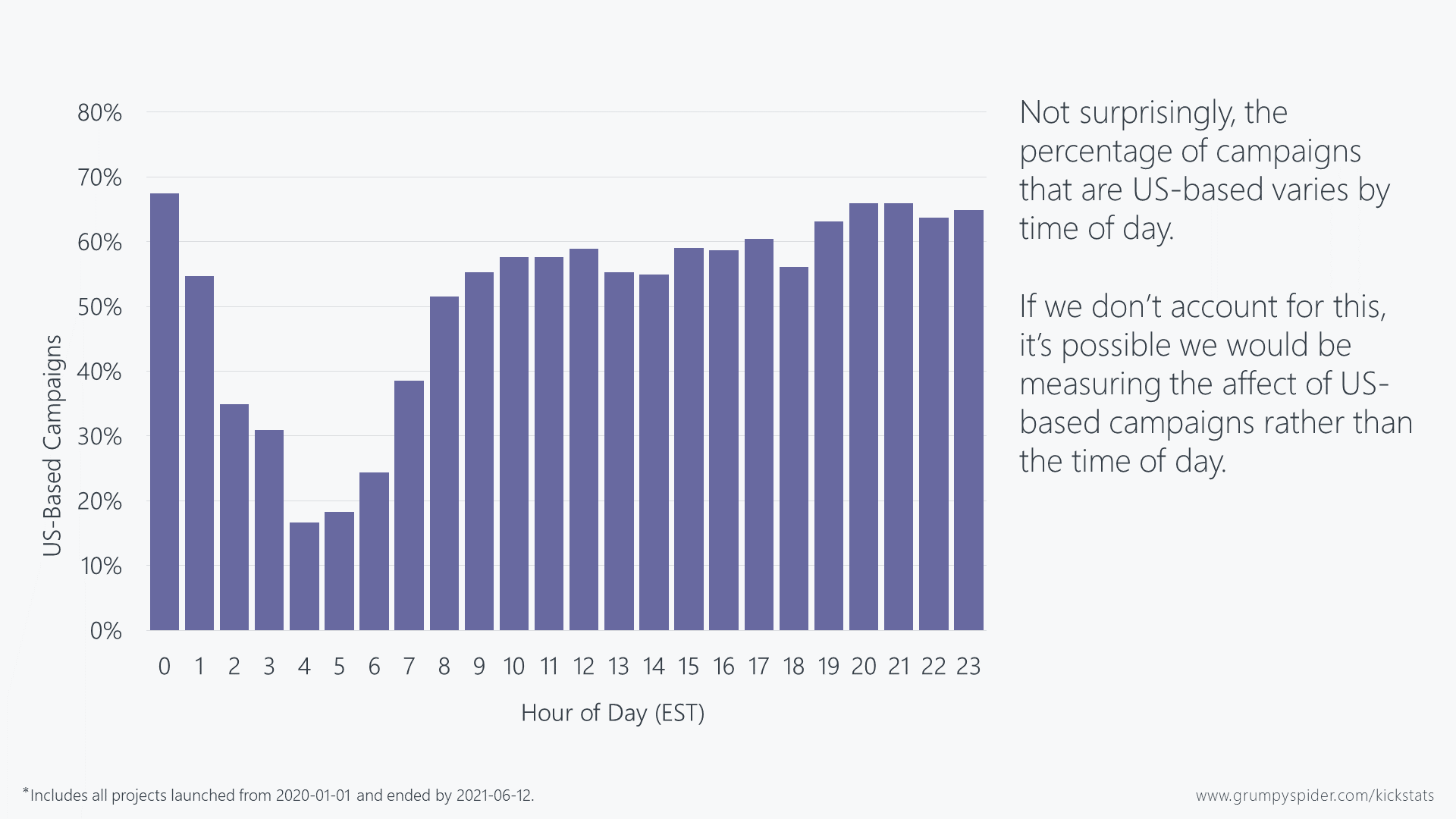
Lastly, we can’t possibly do this analysis justice without considering that the majority of campaigns come from the US. If we say that a particular time of day in the Eastern Time Zone is best to launch, it could just be because a huge number of campaigns happen to come from that time zone. So let’s see how much the US favors particular times of days.
Not surprisingly, US-based campaigns greatly favor certain times of day. Since the US is such a large contributor to Kickstarter campaigns, we need to level the playing field for international campaigns.
Results
That was a good number of possible confounding variables we identified. Let’s see how accounting for them changed our results.
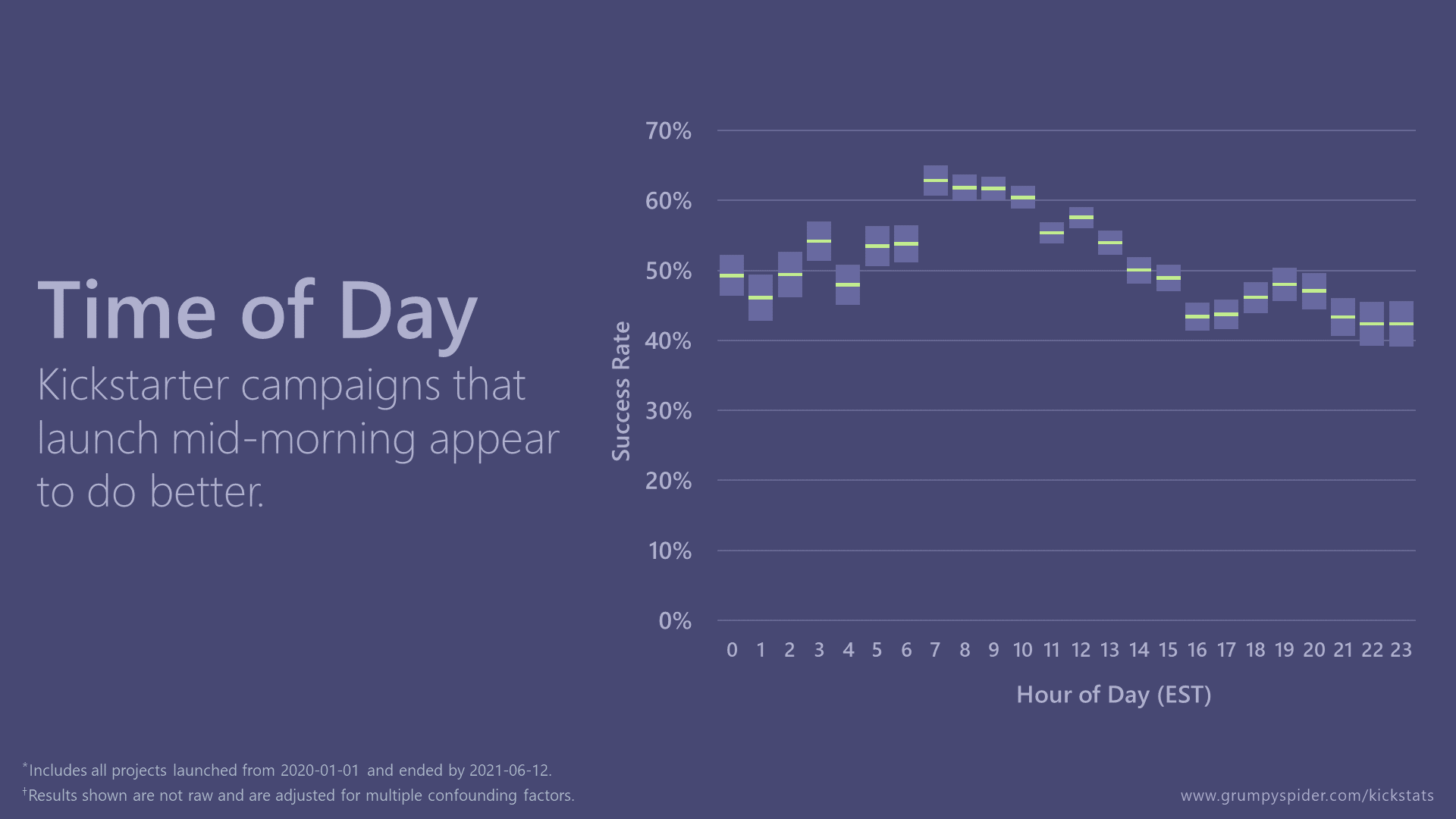
It looks like early- to mid-morning takes the lead, regardless of where you’re from! Campaigns that launch between 7:00 am and 10:59 am (EST) tend to see better results. I’m also a bit surprised that that time range is recognizably better than noon, which is the time that conventional wisdom says you should launch.
Although 7:00 am appears to be the best, it’s important to note that the confidence interval for that time (the purple shaded region) overlaps the intervals for 8:00, 9:00, and 10:00, so we cannot say with confidence that it is better than those times. We can, however, say that it’s better than pretty much another other time of day.
So, my official recommendation is to launch your Kickstarter campaign between 7:00 am and 10:59 am Eastern Standard Time.
What do you think?
Did these results surprise you? What do you think of the jump from 6:00 am to 7:00? Do you think there’s any other factors that might be affecting the analysis? Let me know in the comments!
Have you ever come across a game that – on the surface – looked identical to yours?
As you might imagine, our anxiety jumped a little the first time that happened to us. The last thing we want to do is make a heartless rip off of a game that’s already out there! Thankfully, though, after reading about that game a little more, we realized just how different it really was from Rucksack.
Since then, we’ve come across a few more games that are similar to ours in some way or another. But as we’ve seen more of them, we’ve picked up on a pattern of what really makes Rucksack unique. So I thought I’d write a little bit about what I believe makes it stand out from the crowd.
What is Rucksack?
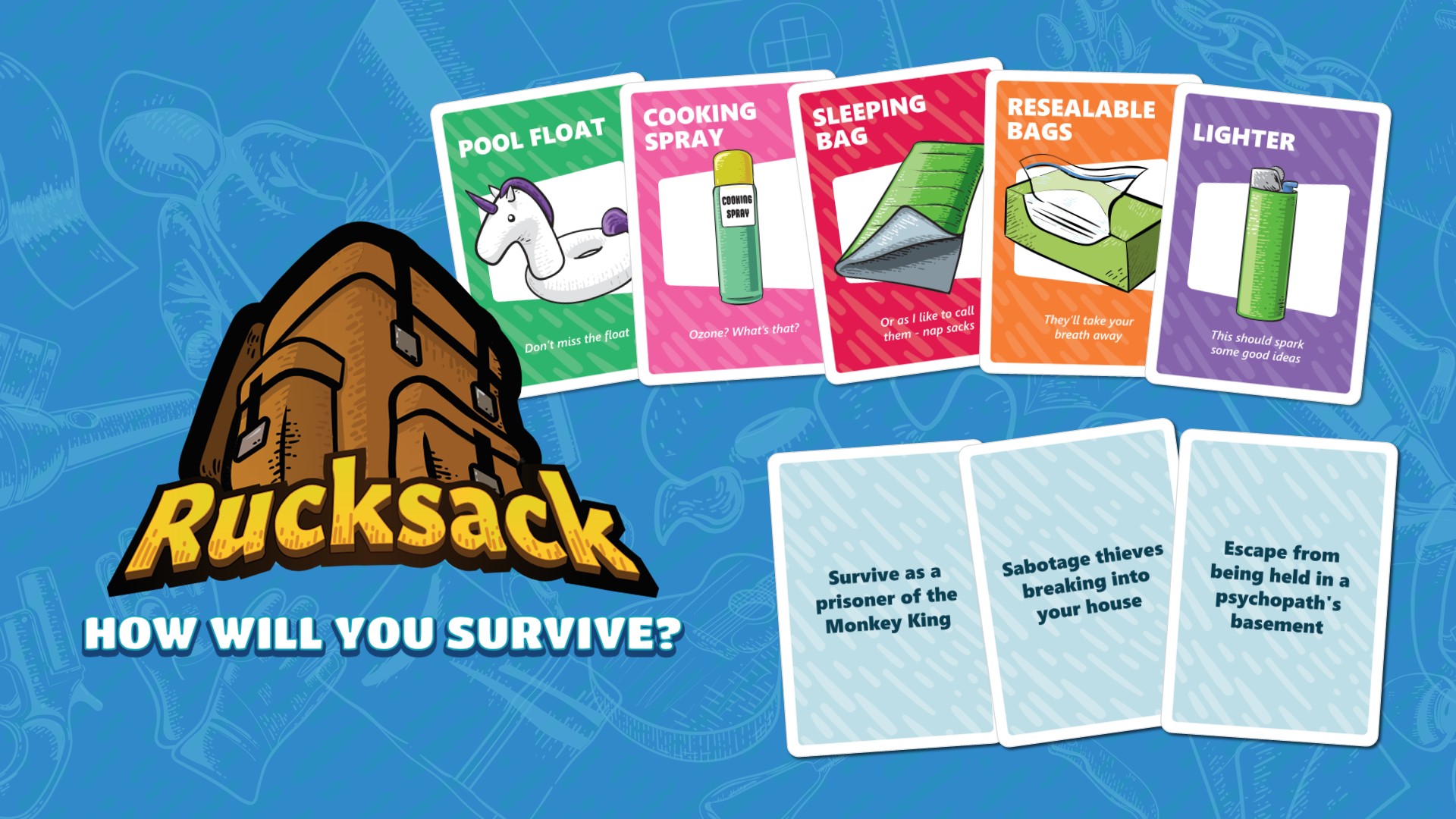
Rucksack is a lighthearted party game that throws each player into the most extreme scenarios you can think of. But don’t worry, you get to collect 5 (maybe not so useful) items to help you survive. It’s up to you to figure out how to use them and convince the other players that you’d make it out alive!
What Makes It Different?
It’s not “Know Thy Judge”
A common pitfall of many party games is that each round has a judge who chooses the winner of the round.
Why is that a problem? Well, because then the game stops being about choosing the cards/combinations that are legitimately the best, and instead becomes about choosing cards you think the judge will most likely pick. What that means is, if you have a judge that’s completely irrational (like one that thinks it’s funny to pick a winner randomly), then the game can really lose its appeal, as the choices you make don’t really influence the outcome.
In Rucksack, there is no single judge per turn. Each round, everyone gets to create a plan and everyone votes for their favorite. That means you have to convince as many people as possible that yours is the best scenario, which makes it much more likely that the winner does, indeed, have the best answer.
Answers Aren’t Hidden
Another downfall of similar games is that the single judge for the turn doesn’t know who gave what answer.
Now, that makes sense to mitigate bias, but if the judge doesn’t know which answer is yours, then it’s hard to argue your case without revealing that it was your answer. What you end up with is the judge reading the choices while the others sit quietly, hoping their answer is picked. Snooze fest.
With Rucksack, everyone knows everyone else’s answers, so it constantly encourages friendly banter as you try convincing each other that “so and so’s” plan is pitiful, while yours is undeniable genius!
Votes ARE Hidden
I can hear you thinking now, “If you know everyone’s answer, then everyone will just vote for whoever’s losing, to give themselves a better chance.”
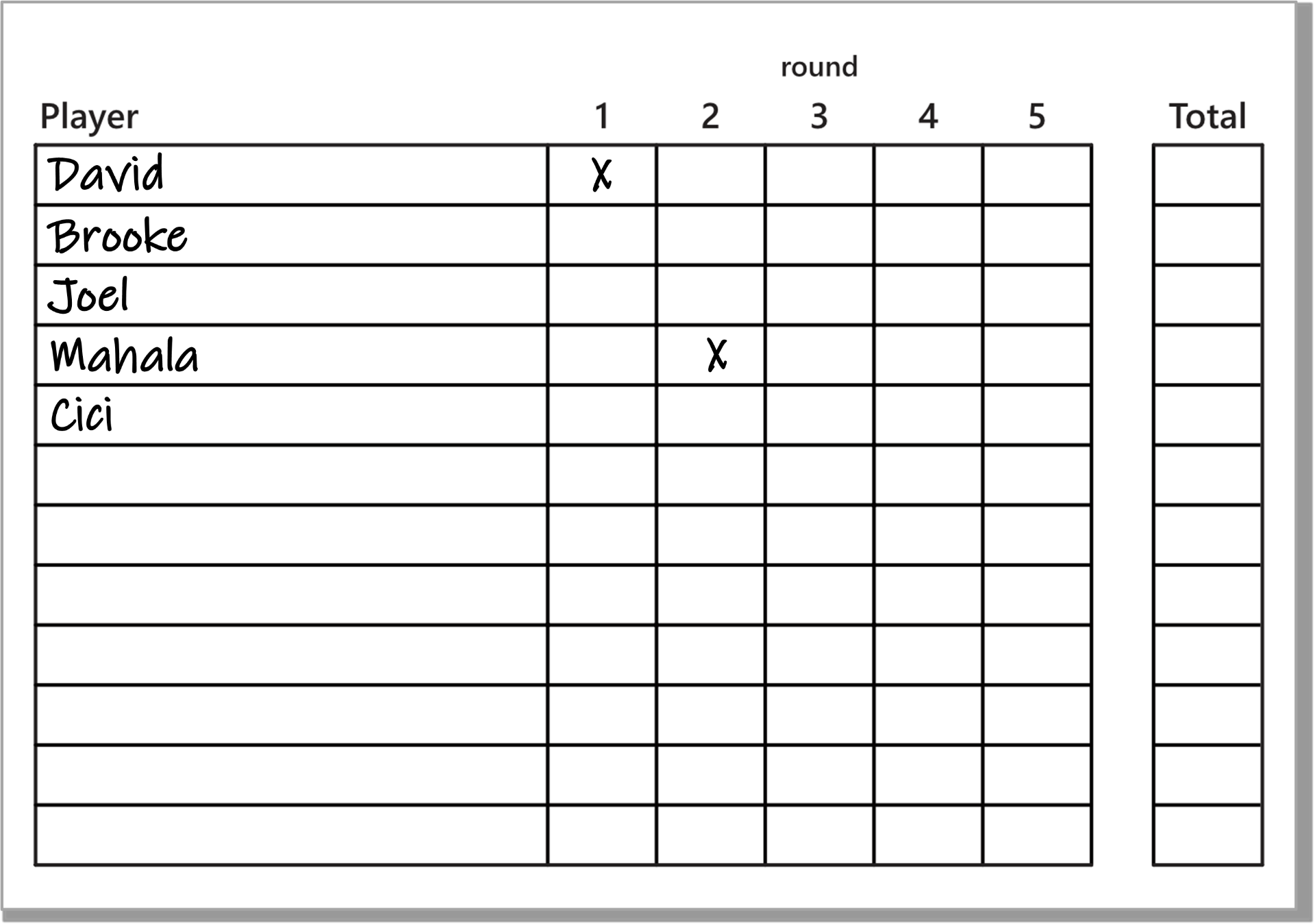
You might be right, if everyone voted openly, but in Rucksack, votes are hidden. Every player is given a voting sheet where they secretly record their vote for the winner. Since no one knows who voted for who, it’s much tougher to just vote for the person with the lowest points.
On top of that, votes are tallied at the end of the game, so you don’t have players that win individual rounds. Instead, you play 3 rounds, and then count who got the most votes of all rounds combined. This helps to further obscure winners and losers until the end of the game.
It’s Not Shock-Value Humor
Rucksack doesn’t really have any low-effort cards that will “get a bajillion laughs no matter when I play it!” Other games that have those can be fun, for sure, but I’m sympathetic to those that say they get old too quickly.
Don’t get me wrong, there are plenty of comical scenarios, and some of the items are a bit ridiculous, but you won’t feel like it’s fill-in-the-blank humor. In fact, you don’t even have to go the humor route at all. There have been a few times where I couldn’t think of anything particularly funny about the cards I had in my hand, so I decided to go the more serious/detailed route, and gained several votes for doing so. Laughs are great, and easy to come by with Rucksack, but it’s not completely dependent on them.
The Game Doesn’t Play You
Some games depend entirely on what cards you have in your hand, and there’s nothing you can do about it. It’s completely luck of the draw. It ends up making you feel like you’re not even playing the game, and more like the game is playing you.
Rucksack, however, actually has real card drawing! There’s still randomness involved, sure, but you have the choice to pick from the discard pile, or if you don’t like the card you draw, you have a chance to trade it for a better card if you’re willing to risk it.
On top of that, there really is no perfect hand, because it heavily favors realcreativity. Having cards that are “perfect” means you’ve got it too easy, and the other players may not vote for your plan. To win votes in that situation, you’ll have to come up with out-of-the-ordinary solutions, instead of just “oh, I have a gun, so I shoot the bad guy”.
Conclusion
Hopefully now you’ve got a better idea of what makes Rucksack such a great game. If you’d like a little more info, take a look at Rucksack’s dedicated page!
Recently, I’ve been updating the posts in our Kickstats blog series with data from the entire year of 2020. Today, however, I thought I’d take a little break from all that to address some of the fears that Kickstarter creators regularly face.
So, here are two of the most common fears of Kickstarter creators and what 16,000 campaigns have to say about those fears.
My Kickstarter’s pledges have drastically slowed. Is my campaign dead?
Here’s the scenario: You just launched your fancy new campaign on Kickstarter and it’s all the rage! Pledges are pouring in and you’re having a hard time keeping up with all the questions, comments, and private messages from backers. Stars fill your eyes as you think about reaching your goal by day 3 of your 30-day campaign (never mind that it should have been a 21-day campaign). With all that extra time, you dream about all the stretch goals you’ll be able to offer!
But then, day 3 actually comes and the clouds start forming. For the first two days, you were gaining new pledges with each page refresh, but now it’s been hours since the last one came in. Just yesterday you were the king of Kickstarter, and now you’re left begging for scraps. What happened? Did your campaign die?
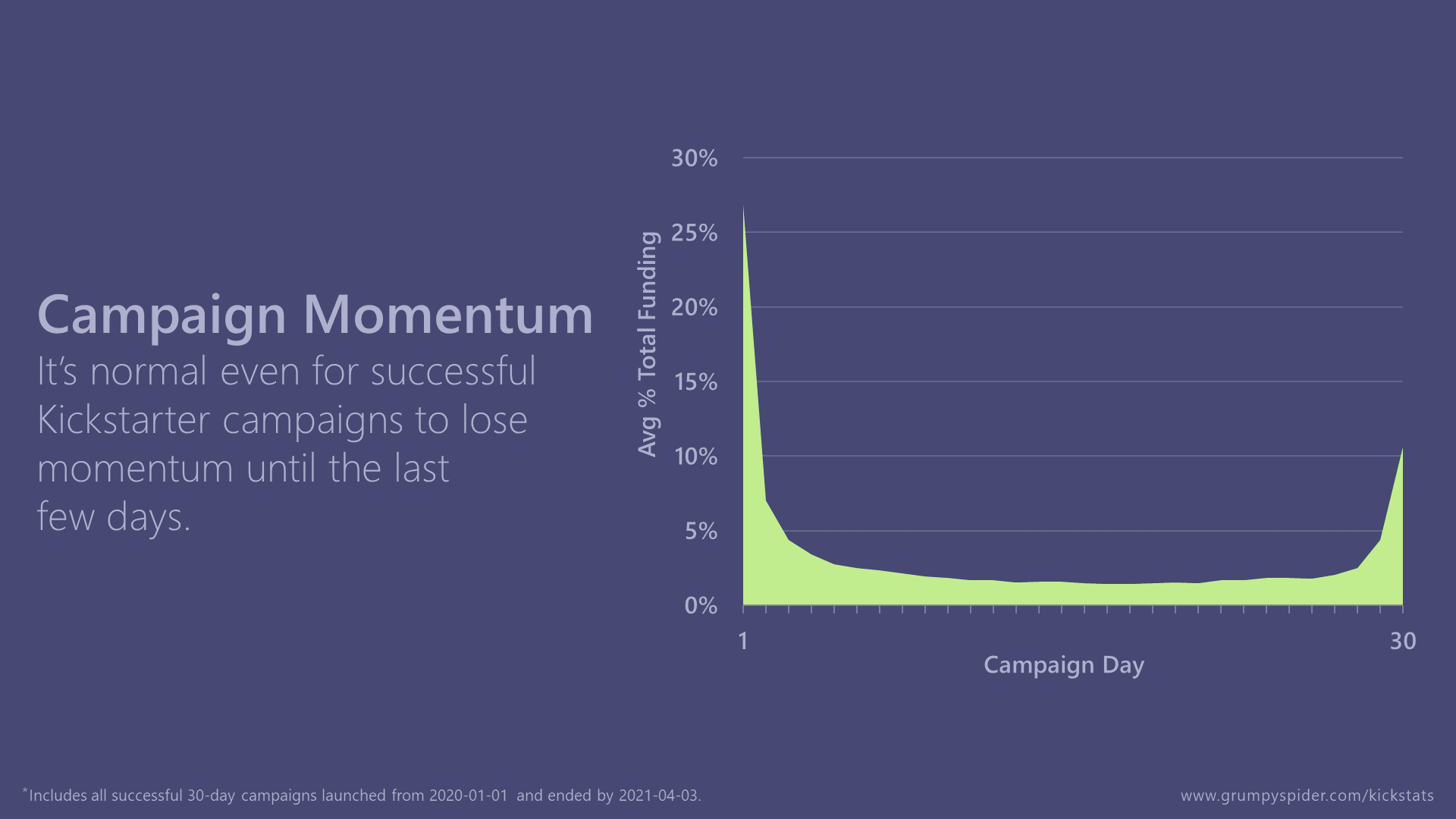
Don’t worry. You’re campaign (probably) didn’t die. This is a common phenomenon for pretty much every Kickstarter campaign out there – even the crazy successful ones. The first few days of almost every campaign are filled with people who have been following your project and are excited to finally back it. That level of excitement comes back during the last few days as you see another surge of backers coming in just before the door closes.
It’s that in-between time that’s a killer, making you wonder if you’ll really make it. Well, here’s graph that will hopefully help calm some of those fears.
There’s obviously a lot of variance here, but on average, even successful campaigns will see the 27% that comes in on day 1 drop down to only 7% by day 2.
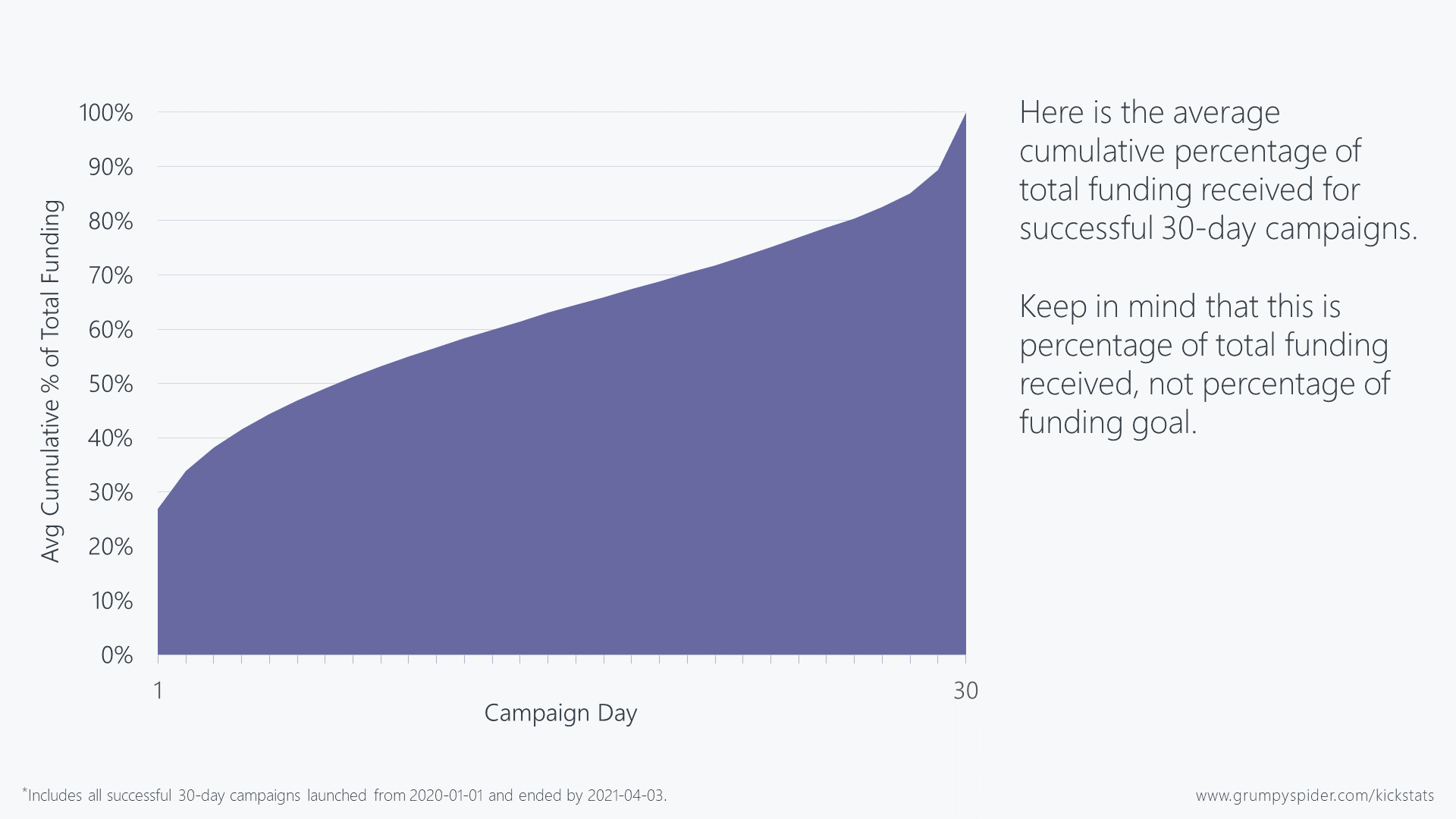
Put another way, you should expect to see something like the below funding progression throughout your campaign.
Notice that the slope is not linear, meaning that some days you’ll receive a lot of pledges and some days you’ll see relatively few pledges. That’s perfectly normal, and nothing to be terribly concerned about.
Of course, that leads right into the next common concern…
My Kickstarter is at X% funding on Day N. Will it fund?
Perhaps that last chart didn’t calm your nerves. Maybe you looked at it and said something like this:
“By day 8, my campaign has probably reached the halfway point of all funding it will receive. But if that’s true, it’s not going to reach the funding goal. Does that mean it’s done for? Is my Kickstarter going to make it?”
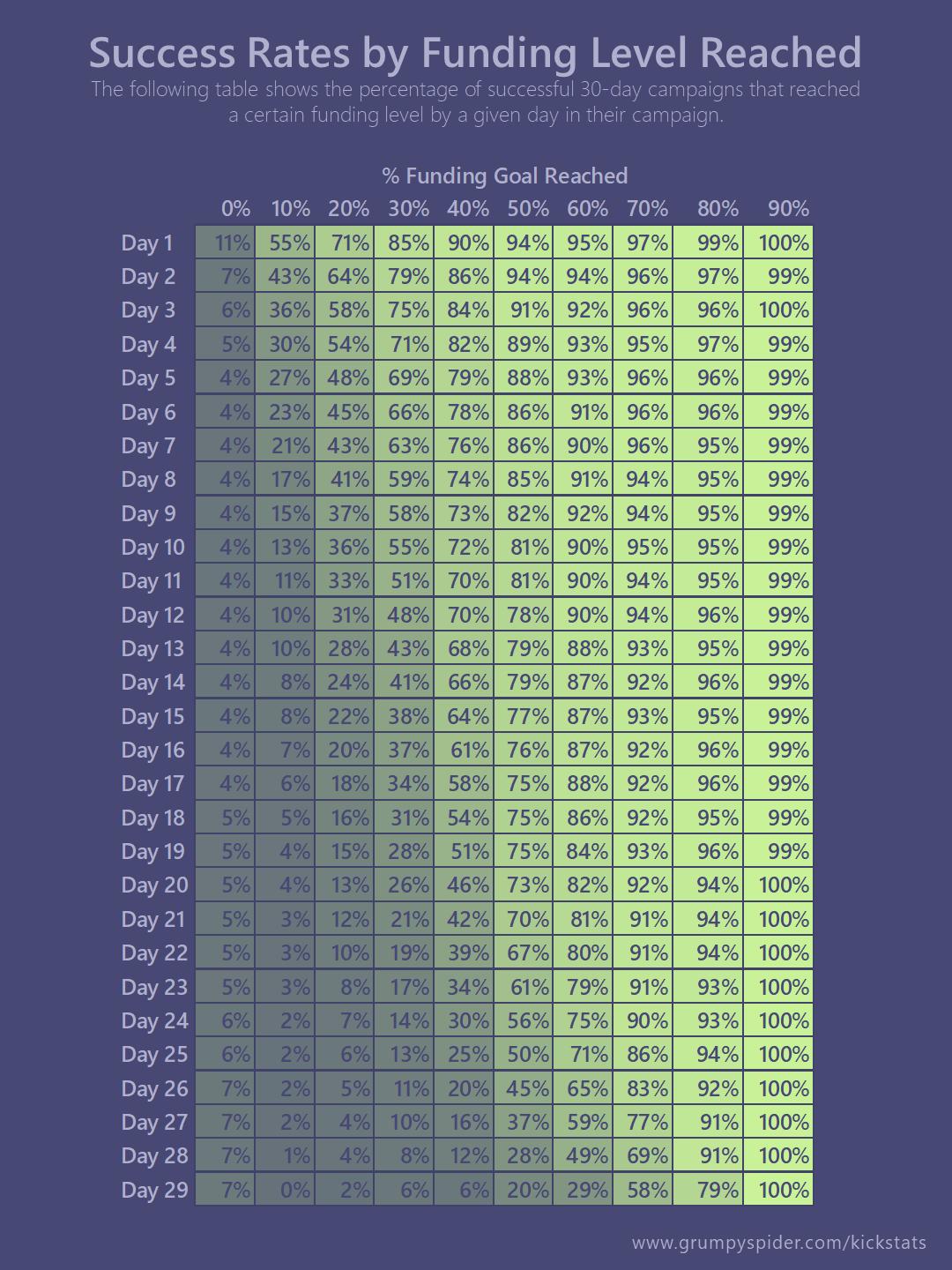
Now this one is a bit harder to predict, but I’ve tracked a little over 16,000 thirty-day campaigns to see where they were in their funding for each day of their campaign.
The below table shows what percentage of campaigns that reached X% of their goal by day N ended up being successful. It can’t tell you if your Kickstarter will succeed, but it can at least give you a general idea of where you’re at. I hope it helps.
I think my Kickstarter is going to fail.
It might be that nothing in this post is comforting to you. After looking at these charts, you realize that, chances are, your campaign just isn’t going to make it. Maybe you’re even weighing the options of cancelling early (more on that later).
I know your pain. That’s exactly where Rucksack was on its first launch. Thankfully though, all is not lost. If you’re willing to stick with it, learn from your mistakes, and try again, you just might get to see your idea come to life.
Conclusion
Being a Kickstarter creator comes with some great highs, but also some real lows. It’s completely understandable to be nervous about where your campaign stands or what the future will look like. Believe me, I’ve been there. But if something in this post – or anywhere else in this blog series – has helped you even a little bit, I’ll be happy.
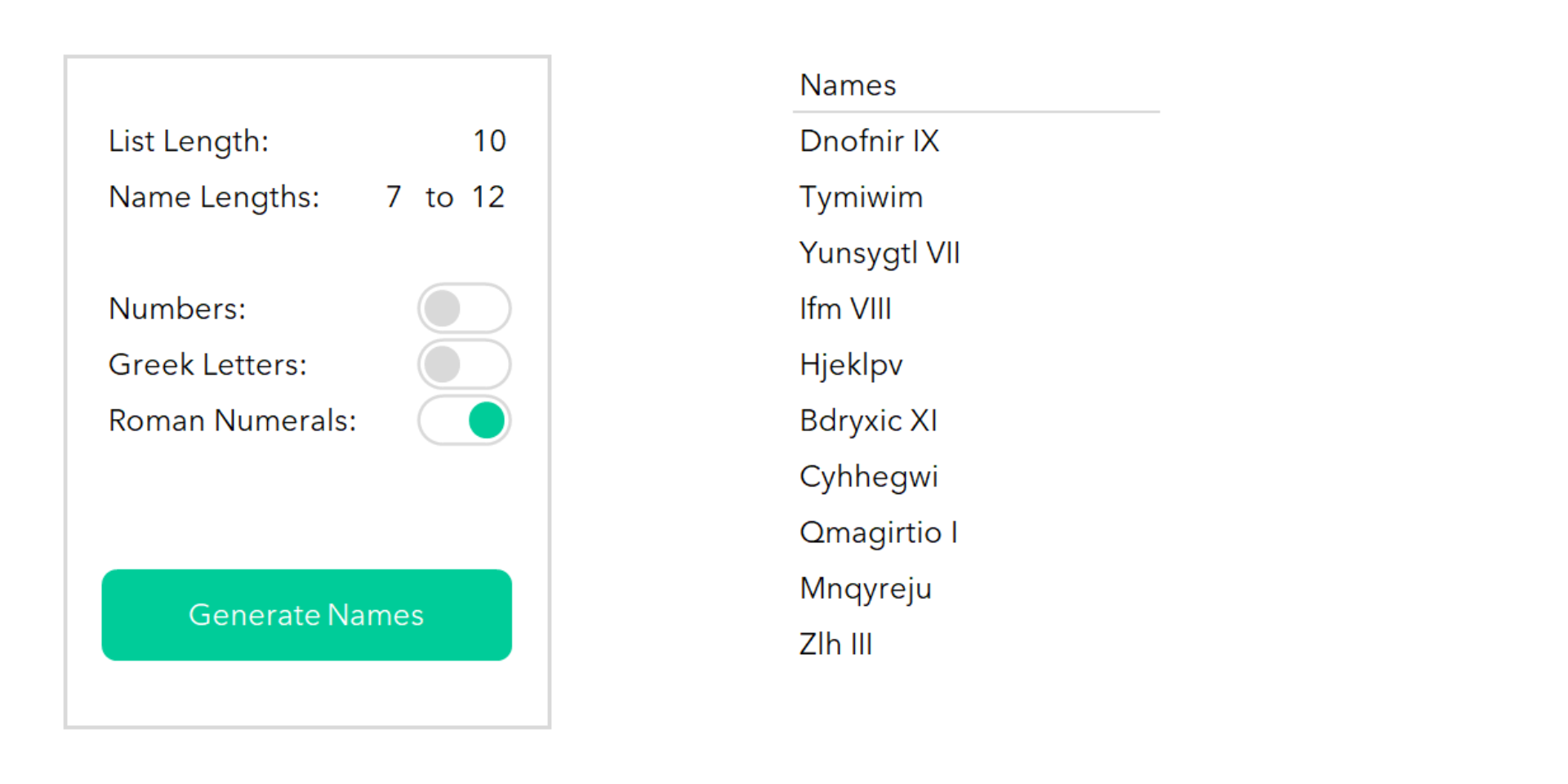
Well, that’s all it took to spark the idea for the second installment of the We Made a Thing blog series: a Random Name Generator!
Description
To be clear, not all the “names” that the generator comes up with look anything like names, since they are just random characters. However, I did add a parameter so that each name will never have more than 4 consonants in a row; so it’s not completely random.
You can also tell it how long you want the names to be and if you want to include specific types of suffixes.
The point is not so much for the generator to create a bunch of perfect names that are just ready to go, but rather to create a bunch of things that kind of look like names. Then you, as a human, can make some small tweaks to turn those strings into great planet, city, or character names!
Basically, it’s designed to quickly get the ball rolling. It starts off the list on its own and you take on the role of the editor, which is much easier than creating names from scratch, if you ask me.
PLEASE NOTE: When you click on the link above, it will look like a Google Sheets file, but it is not one. The generator will only work if you click the download button in the top-right corner of Google Sheets screen, then open the downloaded file in your desktop version of Excel.
This article now includes all Kickstarter campaigns that launched from 2020-01-01 and ended by 2021-05-07. The significant increase in sample sizes has resulted in major changes to the approach, and moderate changes to the outcome, of our original analysis. Portions of this article have been rewritten to reflect those changes.
Introduction
Not too long ago, I answered the question “What’s the best day of the week to launch on Kickstarter?”. In this post, I’d like to cover a related question that you might not have thought of: “What’s the best day to end a Kickstarter campaign?”
Arguments
Although it’s not as hotly debated as the best day to launch, it’s still pretty easy to find opinions and arguments on what day is the best day to end a campaign. General consensus is that Thursday is the best. In fact, Kickstarter itself claims that the best launch/end combination is Tuesday/Thursday, although they offered up no real reason for why that might be.
Personally, I don’t think what day you end on really makes any difference. If Thursday has the highest success rates, I’d guess that’s only because of how closely associated it is with Tuesday launches. Of course, what I think doesn’t really matter – let’s look at the data!
Analysis
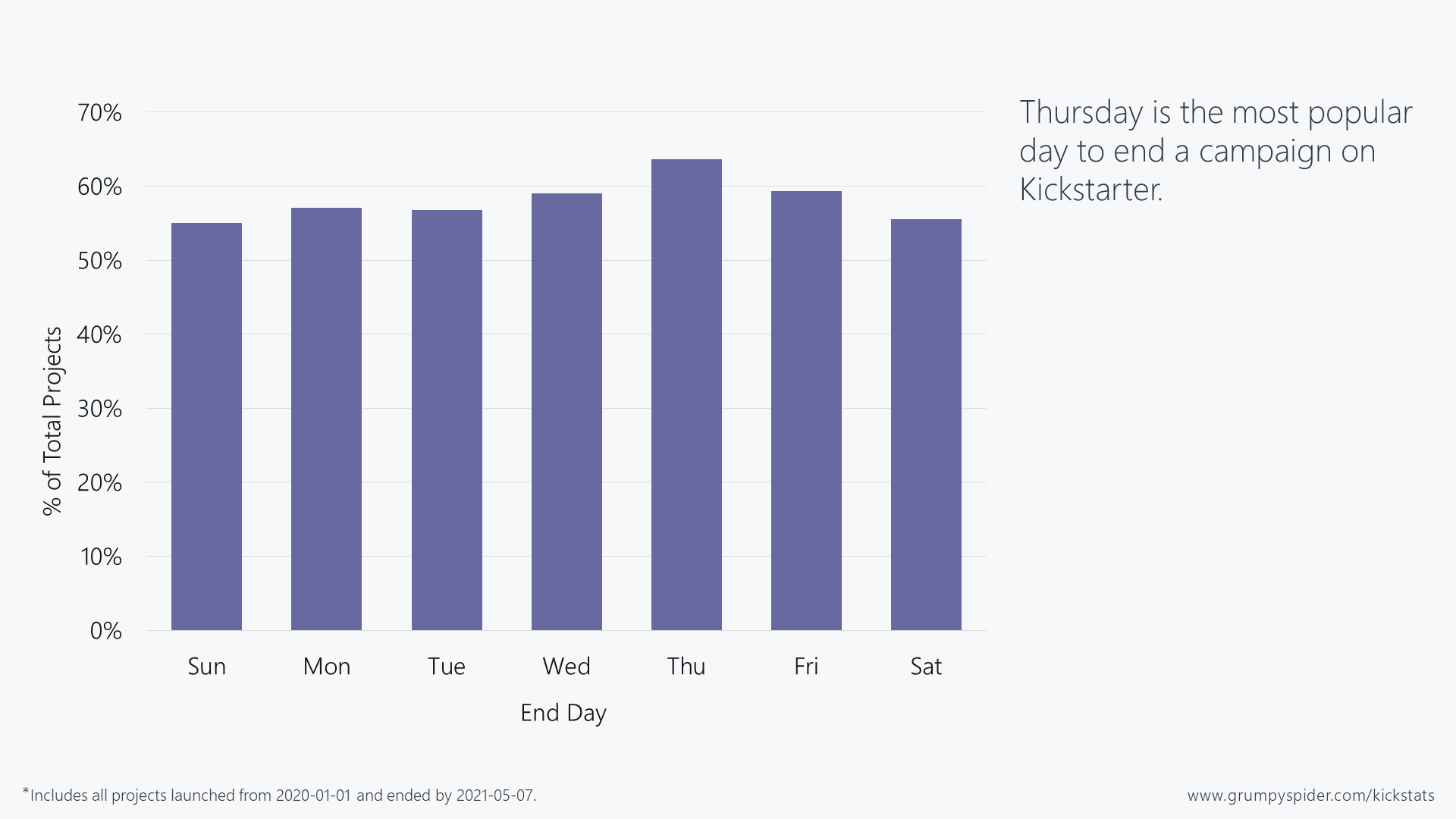
Thursdays are the most popular day to end Kickstarter campaigns, which isn’t too surprising.
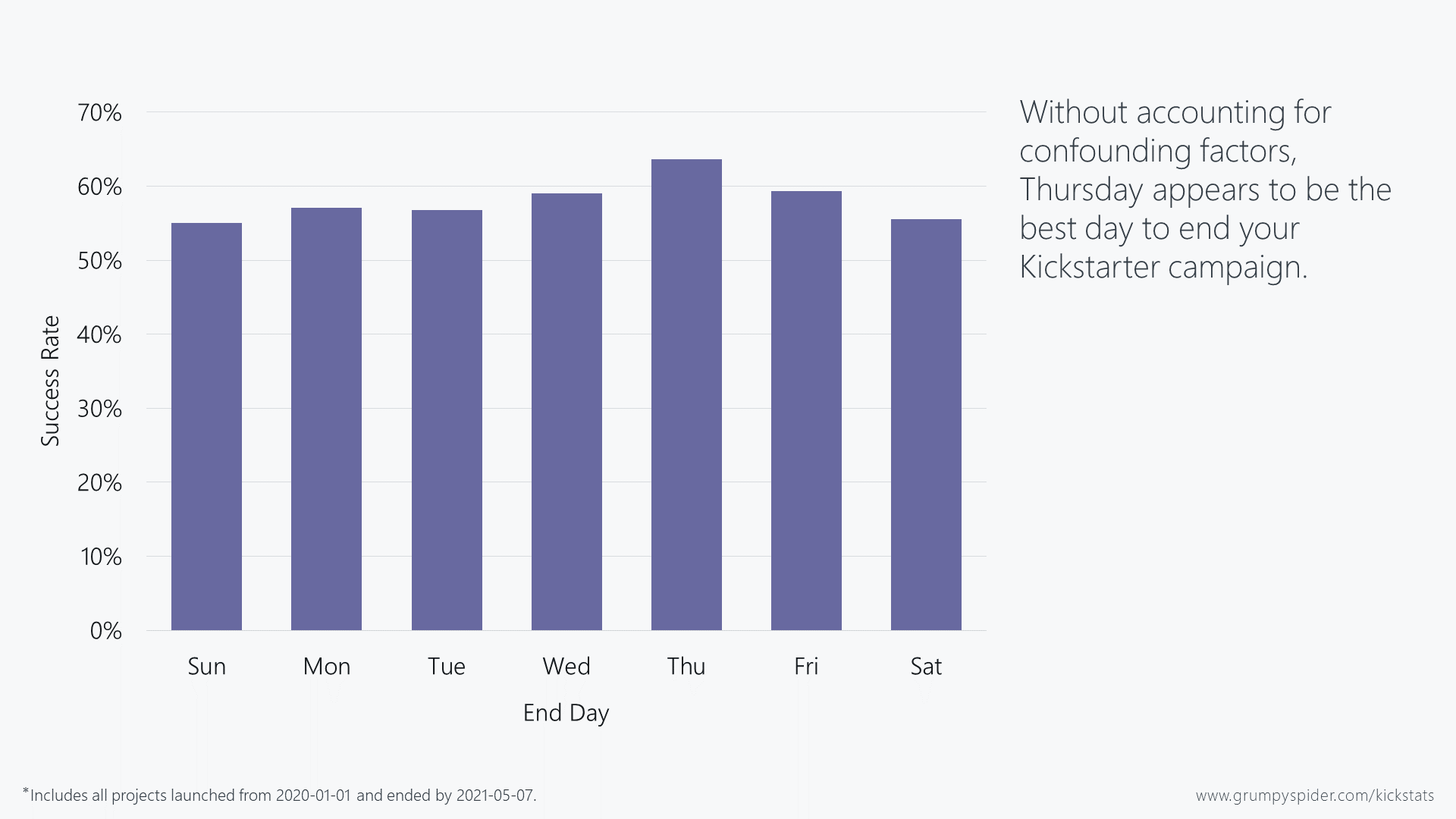
The more important metric, however, is what the success rates are for each end day. Here we see that Thursdays do, in fact, have higher success rates. However, those rates could be due to any number of factors that have nothing to do with choosing that day to end. If we don’t account for those factors, we may end up falsely attributing success to something that makes no real difference.
What are those confounding factors? Well, they turned out to be the same ones that were confounding success rates vs launch day. I won’t go into great detail here, since I already did in that post, but the confounding factors I was able to identify were:
Day of the week that the campaign launched
Proportion of campaigns that were virtually guaranteed success
Proportion of campaigns that were virtually guaranteed to fail
Proportion of campaigns that were tabletop games
The only notable difference in confounding factors between end day and launch day is the proportion of first-time creators. There isn’t any particular end day that has more or less first-time creators than any other. As such, there wasn’t a strong enough case to consider it a confounding factor. Apart from that though, these two analyses are the same.
So, after accounting for all of those factors, what day ends up being the best day to end a Kickstarter campaign?
Results
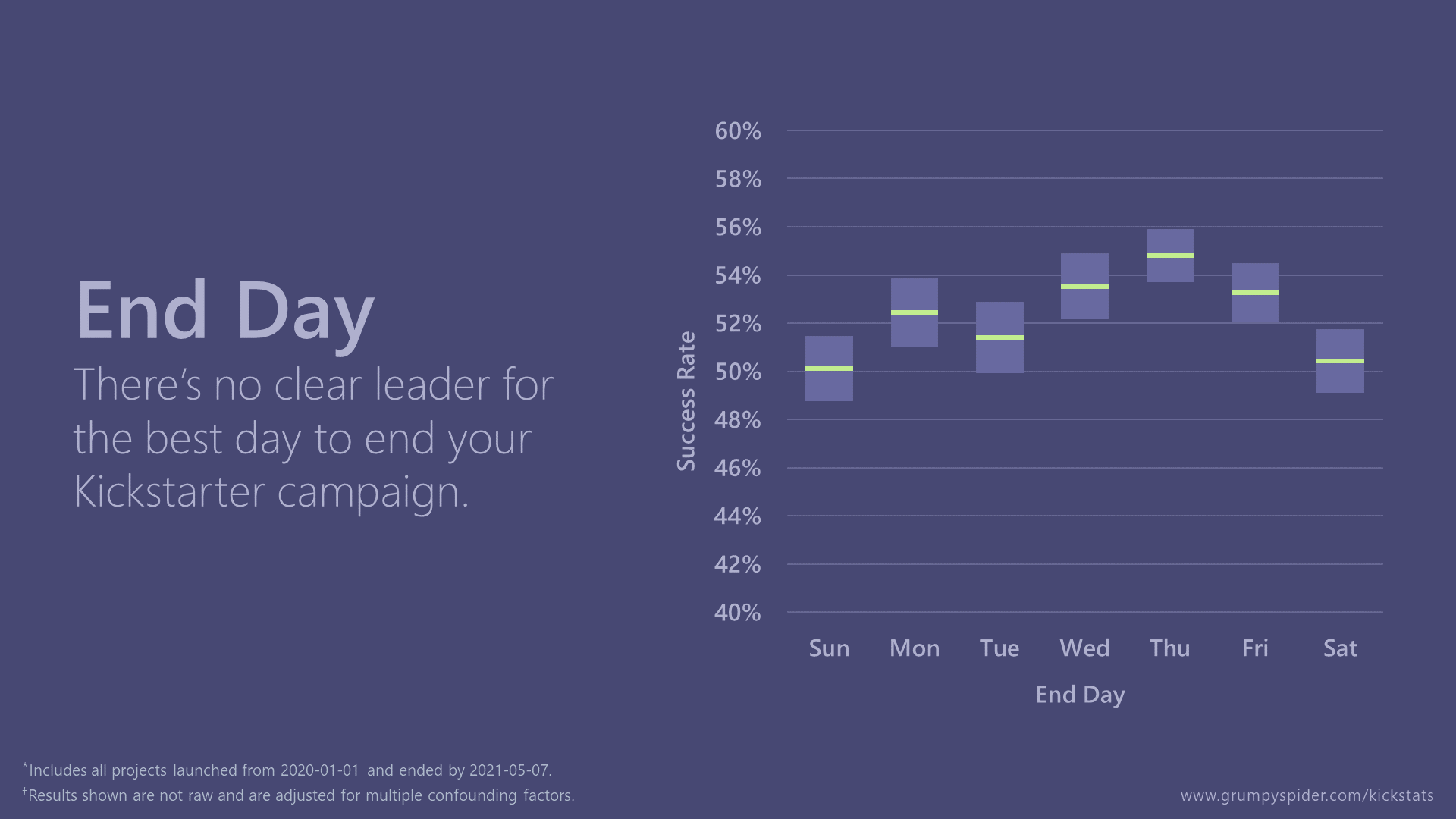
Turns out there really isn’t a clear leader for the best day to end a campaign. We can say with confidence, however, that Thursday is better than Sunday, Tuesday, and Saturday. We know that because the confidence intervals (the purple shaded region) for those days do not overlap with Thursday’s at all.
As for the other days? We really can’t say, because their shaded regions overlap at least by a small amount. So, for instance, because Wednesday’s interval overlaps both Thursday’s and Tuesday’s, we don’t know if Thursday is better than both Tuesday and Wednesday, or if Wednesday and Thursday are both better than Tuesday. We’re just not exactly sure where Wednesday falls. The same goes for any other days whose intervals overlap. All we can say is that, if you have a choice between Sunday, Tuesday, Thursday, or Saturday, Thursday is the best option.
Now, we’ve shown that Thursday is a better day to end than Sunday, Tuesday, or Saturday. The question now is: by how much? For that, we can again turn to the confidence intervals. Let’s take Thursday and Tuesday as an example. By looking at the confidence intervals, we know that Thursday should be better than Tuesday by, at least, the difference between Thursday’s lower bound and Tuesday’s upper bound, and no more than the difference between Thursday’s upper bound and Tuesday’s lower bound.
So what is that range? Anywhere from 0.8 to 6.0 percentage points. Not exactly earth shattering, but hey, every little bit helps, right?
This article now includes all Kickstarter campaigns that launched from 2020-01-01 and ended by 2021-05-07. The significant increase in sample sizes has resulted in minor changes to the outcome of our original analysis. Portions of this article have been rewritten to reflect those changes.
Introduction
Here’s a question I’ve run across a few times in the last several months. It goes something like this:
“I have a few different ideas that I want to bring to Kickstarter, but I can only do one at a time. Should I start with the simplest idea to get the hang of things, or should I go with my biggest idea to really get the excitement going?”
It’s a reasonable question to ask. Starting small would certainly be easier, which would be nice as you learn a ton of new things, but the buzz you could create for that truly awesome idea might help get your campaign over the top and even make your other ideas more successful.
I don’t have all the answers, but what we can do is look at how the ambitiousness of your first Kickstarter campaign might affect its outcome. Once we know that key info, we can use it to help us make the best choice possible.
Before We Start
Using Funding Goal
There’s one big caveat we need to keep in mind with this analysis: we’ll have to assume a Kickstarter campaign’s funding goal is a reasonable indicator for how ambitious a project is. There are literally thousands of campaigns to analyze! There’s no way I can go through each individual project and determine its scope. If we’re ever going to get through them all, we’ll have to use the goal as a proxy.
Here’s why I think that’s OK. If the funding goal of a project is $30,000, It’s usually because the project is large enough to justify that goal. Now I recognize that, occasionally, there are campaign’s whose goals are way larger than called for. That’s not going big – that’s going greedy. There are also campaigns that put their funding goal far too low so they can look more successful than they actually are. But after trying a few different ways of filtering out those campaigns, I found that they really don’t make a huge difference in the findings. When I removed the unrealistically low or high goals, the results only changed by around 3-5%, and that change was consistent across several other factors. So whether you leave them in or take them out, you’ll pretty much draw the same conclusions.
Tabletop Kickstarters Only
If we’re going to use the funding goal as a proxy, then we’ll definitely have to limit the scope of our analysis to a single category. Why? Because different categories will have vastly different funding goal ranges. Think about it – what might be a completely acceptable goal for the latest tech is likely way higher than the average goal for, say, enamel pins.
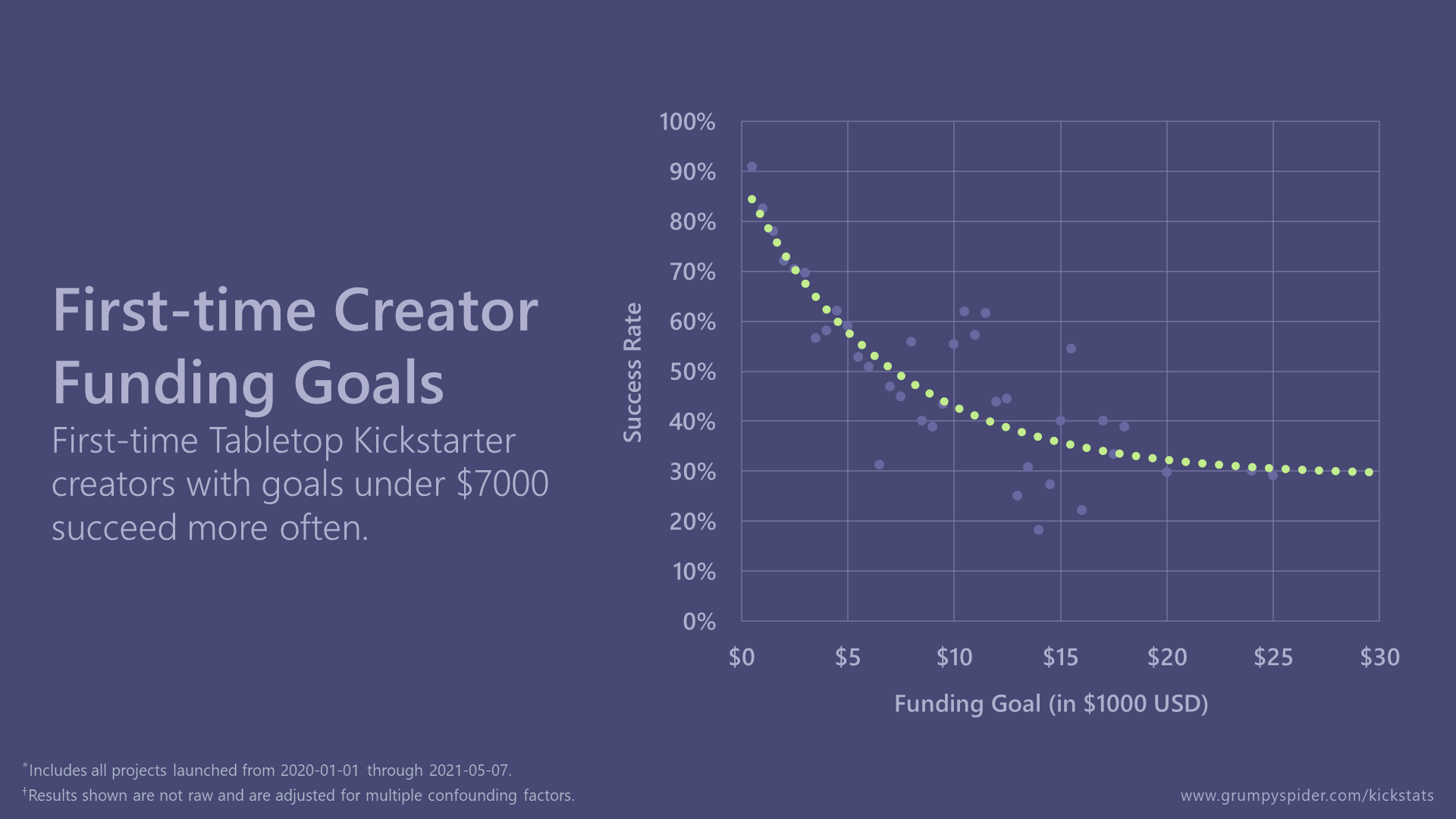
I sympathize with anyone who really wants to dive right in with their big, awesome idea, but I have to admit that the outcome doesn’t look good for those that do.
For first-time tabletop Kickstarter creators, there’s an undeniable negative correlation between funding goal and success rates. The chart above shows that the $7000 mark is right around the point where more campaigns fail than succeed.
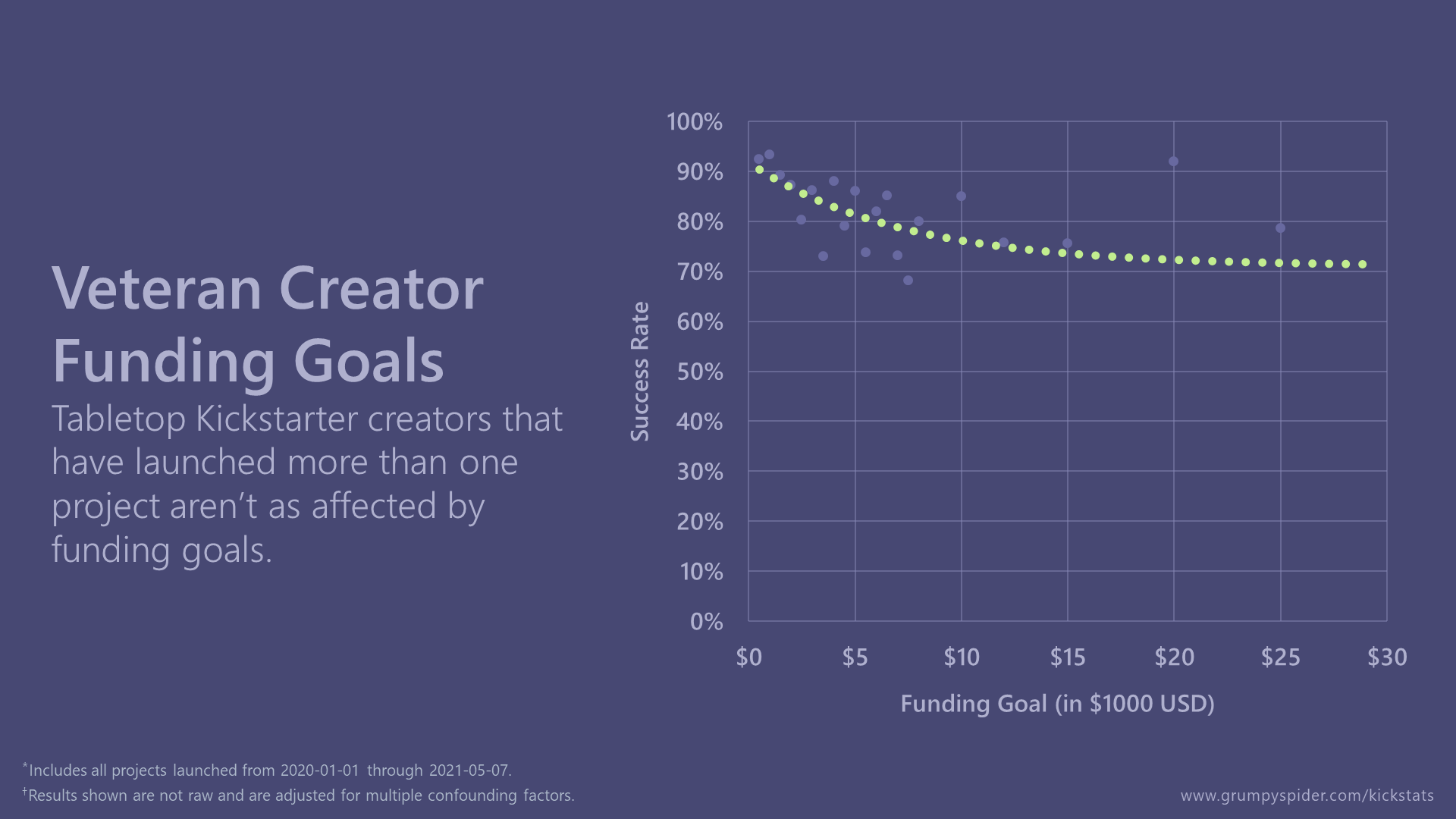
But that’s just for first-time creators. Now compare that to campaigns that don’t come from first-time creators.
For subsequent campaigns, the success rate isn’t nearly as affected by the goal as first-time creators are. As the goals get larger and larger, the outcomes do become less predictable, but the downward trend is almost non-existent, which indicates that other factors are more important now.
We also shouldn’t ignore the fact that larger, more complex projects are much more difficult to fulfill – especially for anyone who’s inexperienced. If you decide to go big and then flounder with the actual execution of the project, you’ll seriously hurt your ability to fund later campaigns.
Based on the above analysis, I would highly recommend that first-time creators start humble and work their way up to larger projects.
What Are Your Thoughts?
Do you agree with my conclusion? Are there extenuating circumstances that are worth considering? Let me know in the comments below!
This article now includes all Kickstarter campaigns that launched from 2020-01-01 and finished by 2021-05-07. The significant increase in sample sizes has resulted in major changes to the approach and outcome of our original analysis. Significant portions of this article have been rewritten to reflect those changes.
Introduction
One question I’ve been obsessing over as we work toward Rucksack’s Kickstarter launch is the same question that seems to be on every Kickstarter creator’s mind. What day of the week should we launch?
Everyone kind of “knows” that the day you choose makes a difference. It’s also one of the easiest tweaks you can make to a campaign. So why not help yourself out by getting this simple aspect right?
The trouble is, which day is actually best? You can find all sorts of input online for that question, but most of the evidence is anecdotal or reason-based. How many people can definitively say that one day is “this amount better” than some other day? Well, my goal for this post is to use the stats from over 40,000 campaigns to do just that!
Arguments
As I mentioned earlier, it’s not too hard to find plenty of opinions on this question. The general consensus seems to be that weekends are bad, since people are out and about and not really browsing Kickstarter. Fridays aren’t good either, since people are rushing to finish up their projects for the week. Mondays should be avoided as well, since people are trying to catch up on any work they didn’t finish from the previous week.
That leaves Tuesday, Wednesday, and Thursday. They’d all be about the same, except that Fridays/Weekends are bad, so you’d want to give yourself as much time before that to gain momentum for your campaign. Thus, Tuesdays are the best!
Those arguments are perfectly reasonably, but there are opposing arguments as well. Despite the thought that workers are busy catching up on last week’s work, Mondays are actually the most popular day for online shopping.
On top of that, since Tuesday is generally considered the best day to launch on Kickstarter, it’s also the most popular day to launch. That could lead to over-saturation, causing it to no longer be the best day due to all the different campaigns that are essentially competing against each other. Then add to that the fact that many of the largest campaigns love to launch on Tuesdays, which puts it into sort of a “self-fulfilling prophecy” situation by making Tuesday’s success rate look higher, even though those campaigns would have succeeded no matter what day they launched.
All that leads to the possibility that Tuesday isn’t the best day for your Kickstarter launch. In fact, it might be Monday. Or maybe it doesn’t really matter after all.
So let’s dive in!
Analysis
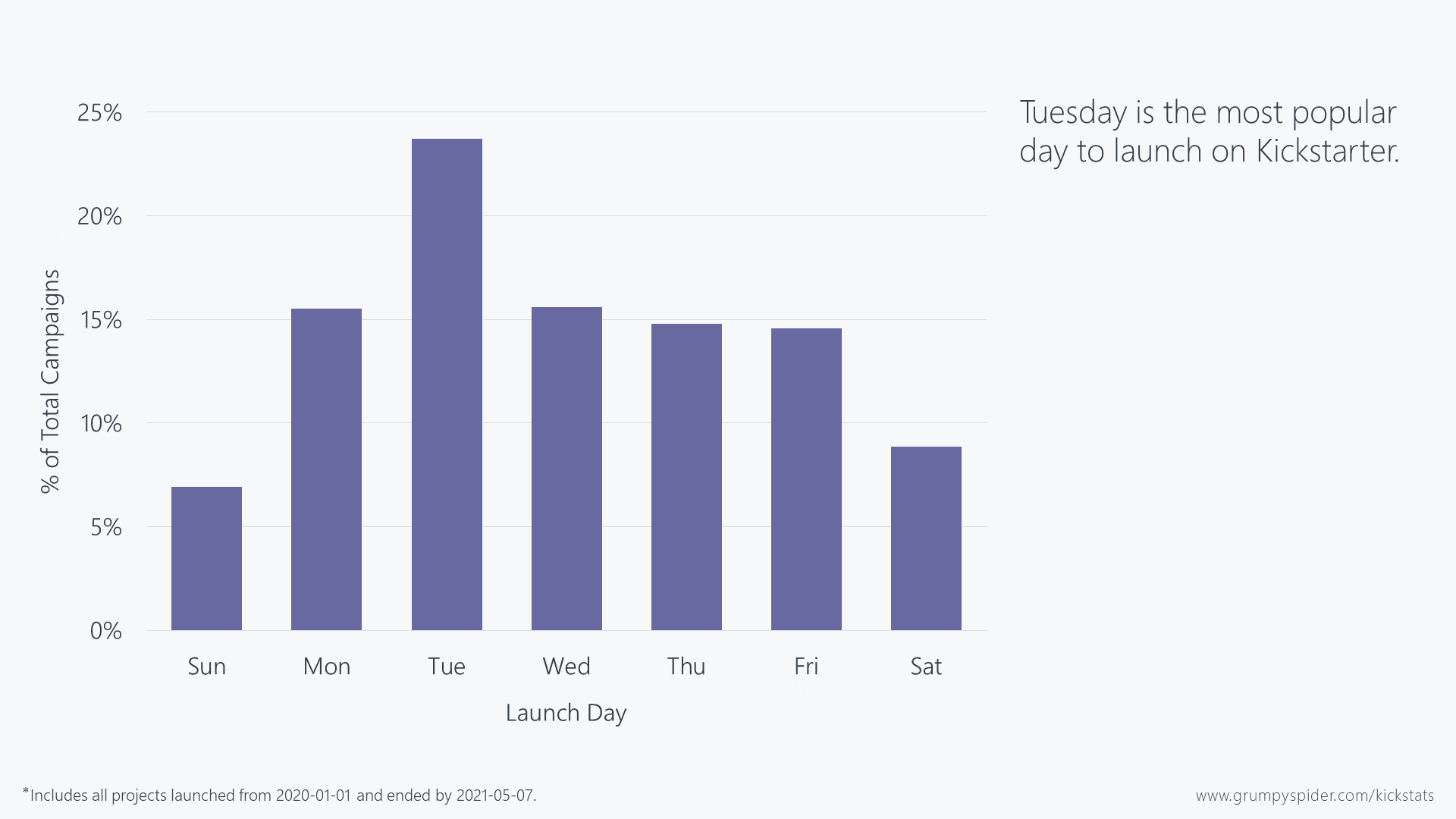
As you might expect, Tuesdays are the most popular day to launch by a decent margin.
But popularity means nothing. In fact, having too many campaigns launching on the same day could cause unnecessary competition, actually making it harder to succeed. What we really want is success rates. What day of the week has the highest success rate for launching campaigns?
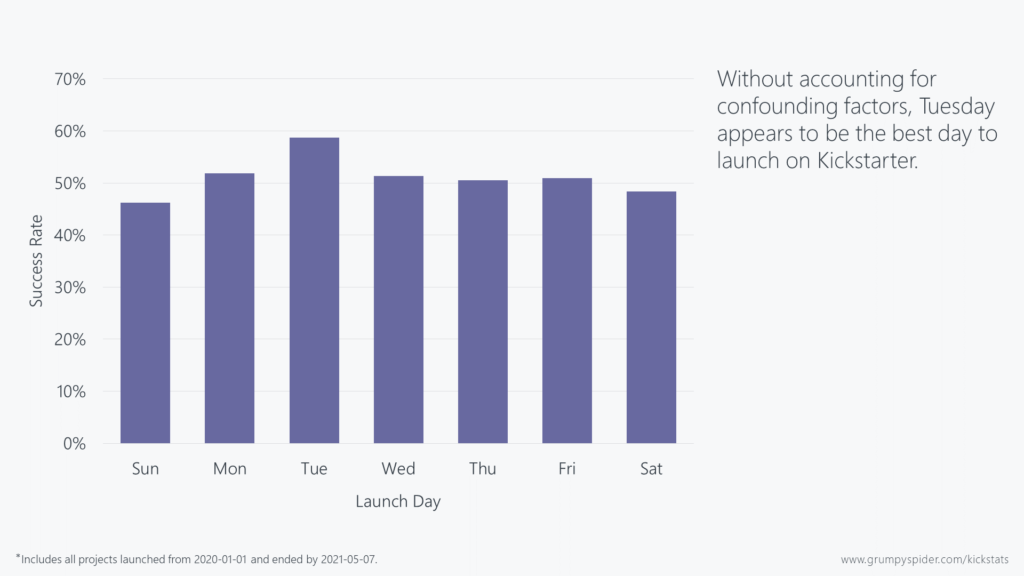
“Ha!” you say, “Tuesday’s are the best day to launch!” Well, not so fast. We have to be very careful of potential lurking variables – those sneaky factors hiding in the shadows of your data that love to screw everything up.
Lurking Variables
When it comes to a question as hotly debated as what day to launch your Kickstarter campaign, it’s important to take extra care to identify and address as many of these confounding factors as possible. So let’s get started.
Guaranteed Successes
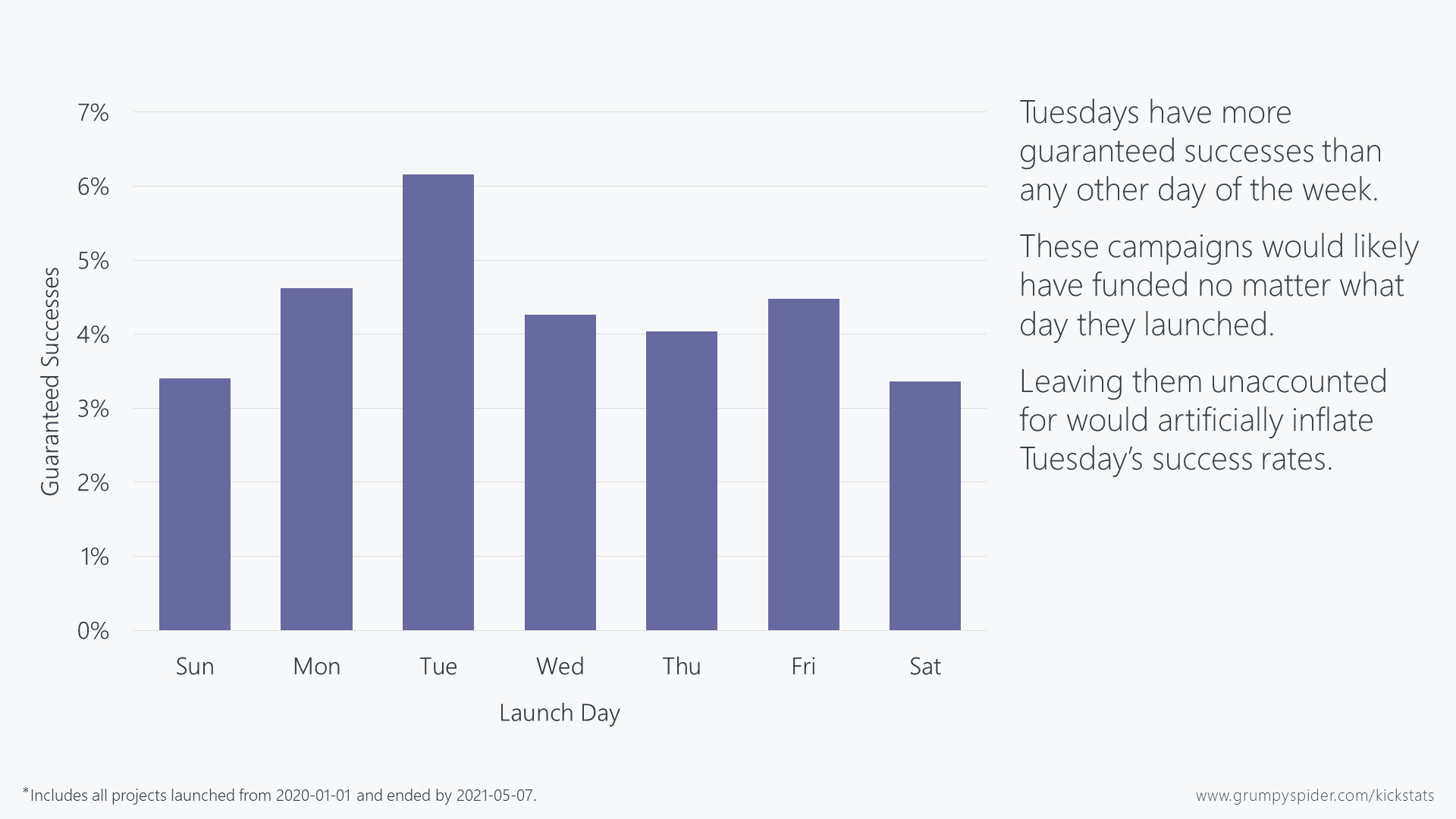
Remember how I mentioned that all the mega campaigns love Tuesdays so much? These campaigns would have succeeded no matter what day they chose.
For example, the hit board game, Frosthaven, blew past its $500,000 goal within the first few minutes! Now, do you think that if they’d launched on a Sunday instead of a Tuesday, they’d suddenly fail to fund? Of course not! It doesn’t matter what day they launched, they were virtually guaranteed success. The fact that they chose Tuesday only serves to make Tuesday look better than it really is.
So, let’s identify and adjust for these Kickstarter hits.
It’s a bit difficult to explain the process, but I was able to use combinations of a creator’s prior track record and funding goals to identify groups of Kickstarter projects that had >99% chance of success before they even launched. I’d say that’s about as “guaranteed” as you can get!
Now, of these campaigns, let’s take a look at what day they prefer to launch.
Just as expected, Tuesday has more guaranteed successes than other days of the week. This speaks a little to the artificially inflated success rates of Tuesdays.
Guaranteed Failures
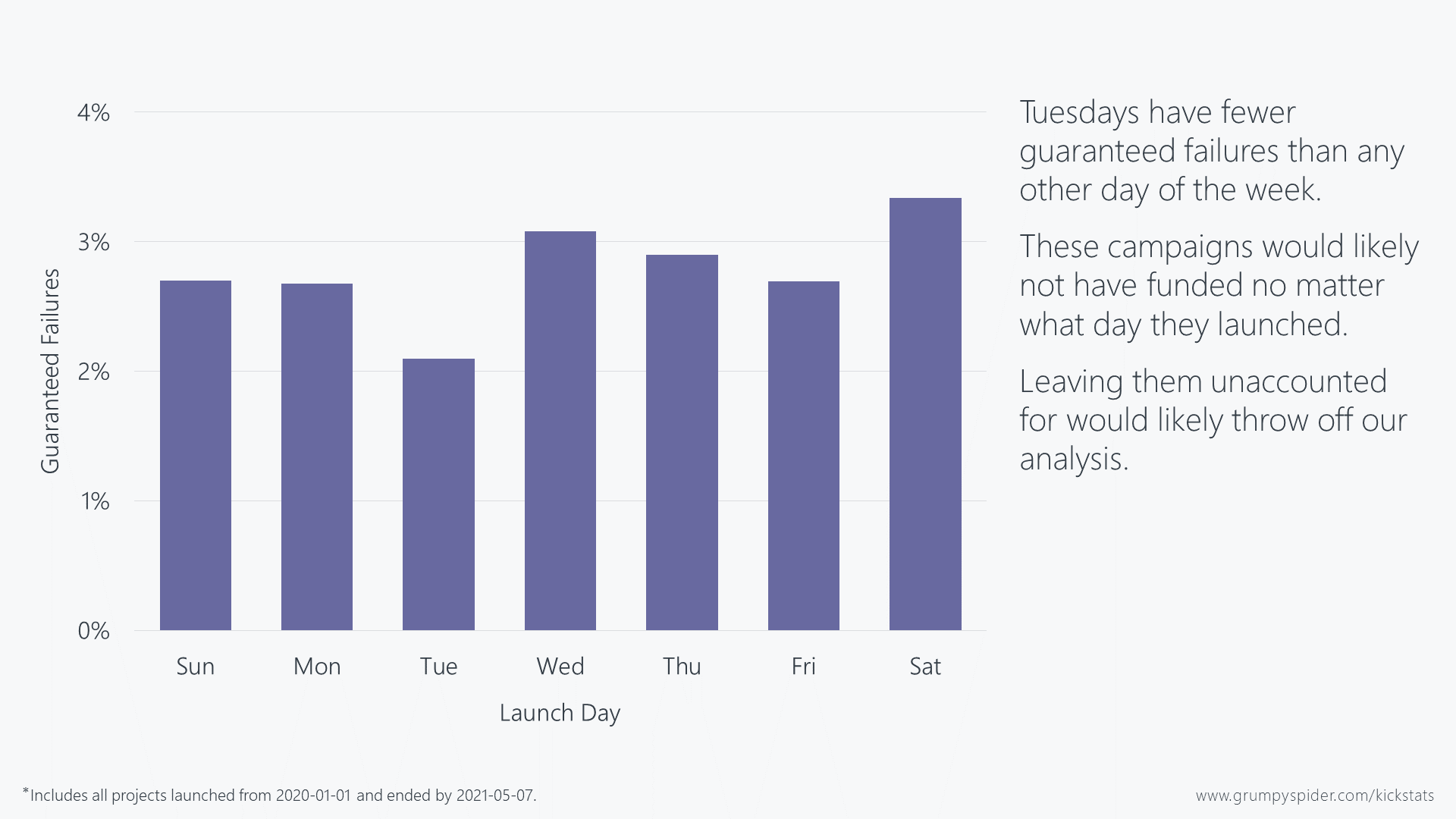
On the opposite end of guaranteed successes there are guaranteed failures. Anyone who’s been around Kickstarter has come across a campaign like this at some point. Maybe these creators don’t value community or transparency, or their funding goal as just far too high. Many times, it’s a combination of all three. These campaigns would have failed no matter what day they launched.
Let’s graph these campaigns by the day they launched to see if we need to adjust our analysis around them.
Once again not surprisingly, Tuesdays have the fewest campaigns that would struggle to fund no matter what day they launched.
Now, you might think this is actually proof that Tuesday is a better day to launch – that fewer campaigns struggle on that day precisely because it’s a better day to launch. That’s possible, but I think it’s more likely that this is a self-fulfilling prophecy.
Let me explain.
Creators that put in the preparation will almost certainly run into someone that says to launch on Tuesday. After researching it a bit, they’ll find even more people that say the same thing. With so many people saying that Tuesday is best, that’s when they’ll likely decide to launch. It couldn’t hurt, right?
Then, because of their hard work, preparation, and research, their campaign succeeds! But their success was due to the work and research, not the day they launched.
Essentially what we have is that Tuesday’s popularity as a launch day is due largely to people that are more likely to do the work and research. The creators that don’t do as much research and work aren’t as likely to come across the arguments for a Tuesday launch, so aren’t any more likely to choose Tuesday. Thus, Tuesdays will have proportionally fewer campaigns that struggle.
Campaign’s Last Day
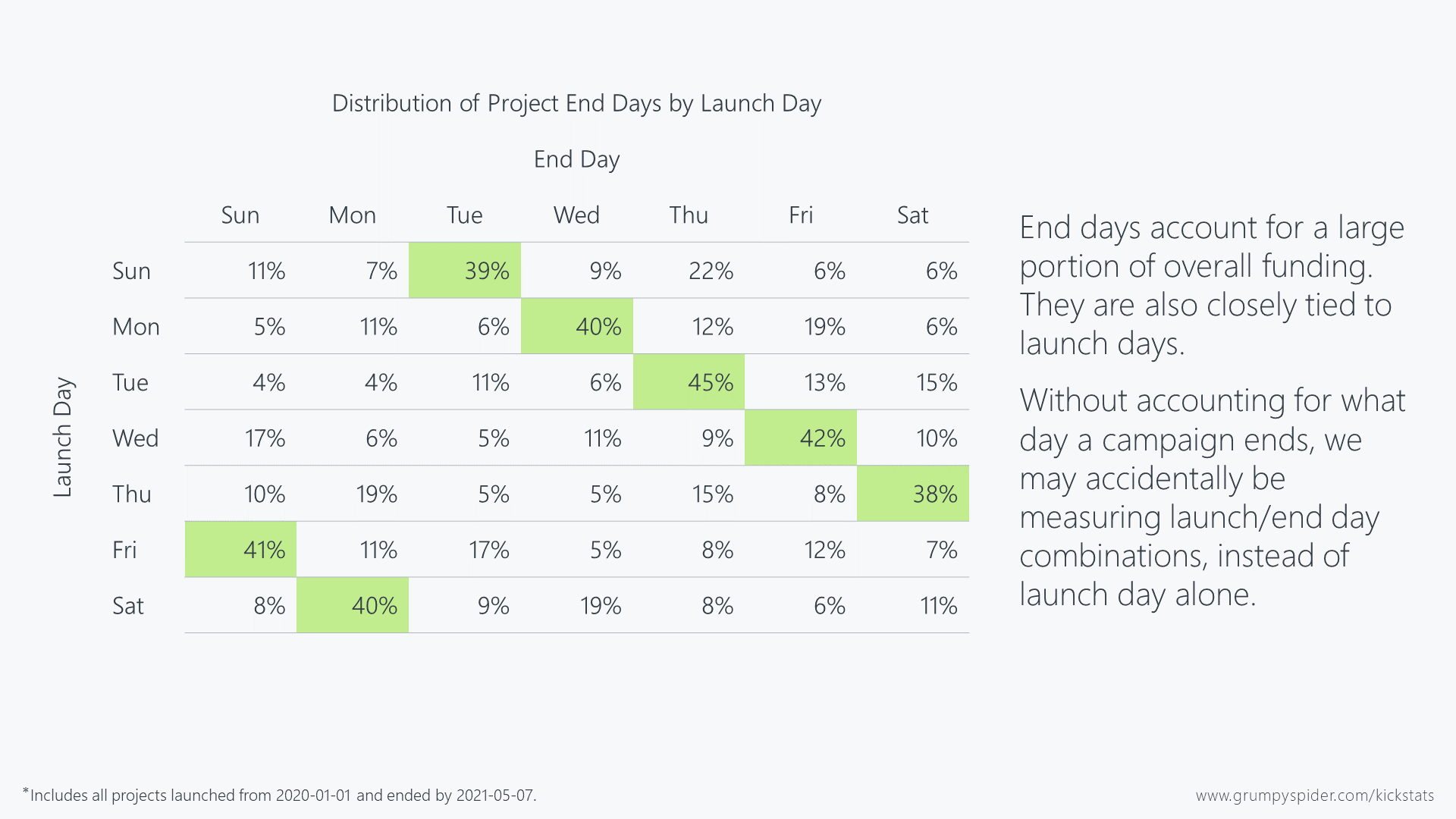
Another possible confounding factor is what day of the week a campaign ends. Tuesday campaigns are far more likely to end on a Thursday than any other day of the week.
So what if it’s not the day you launch that matters, but the day you end?
Well, we already showed that the day you launch is more important than the day you finish, but we also showed that the day you finish carries a good bit of weight. So when we say Tuesday is the best day to launch, we could accidentally really be saying that a launch/end combination of Tuesday/Thursday is the best. But what about Tuesday/Sunday combinations, or any other for that matter? We’ll need to even the playing field for this as well.
First-time Creators
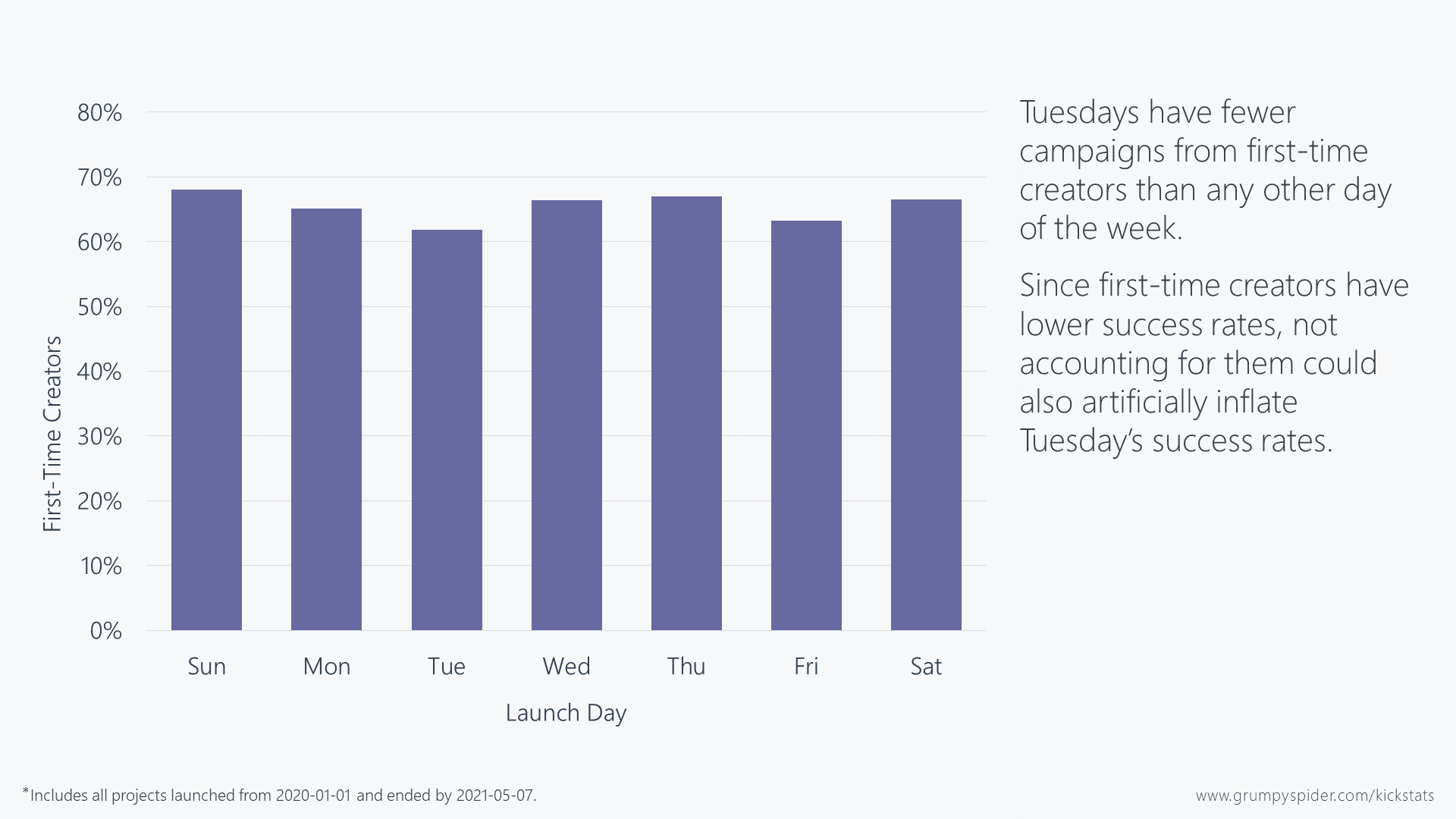
We’ll also want to check for first-time creators, since they have lower success rates. If inexperienced creators like to launch on a particular day of the week, it would make that day look worse than it actually is. So let’s check the distribution of first-time creators by launch day.
For the most part, the days aren’t too far apart with how many first-time creators are launching, but the gap between Sunday and Tuesday is large enough where it’s probably good to account for it, just to be safe.
Tabletop Games
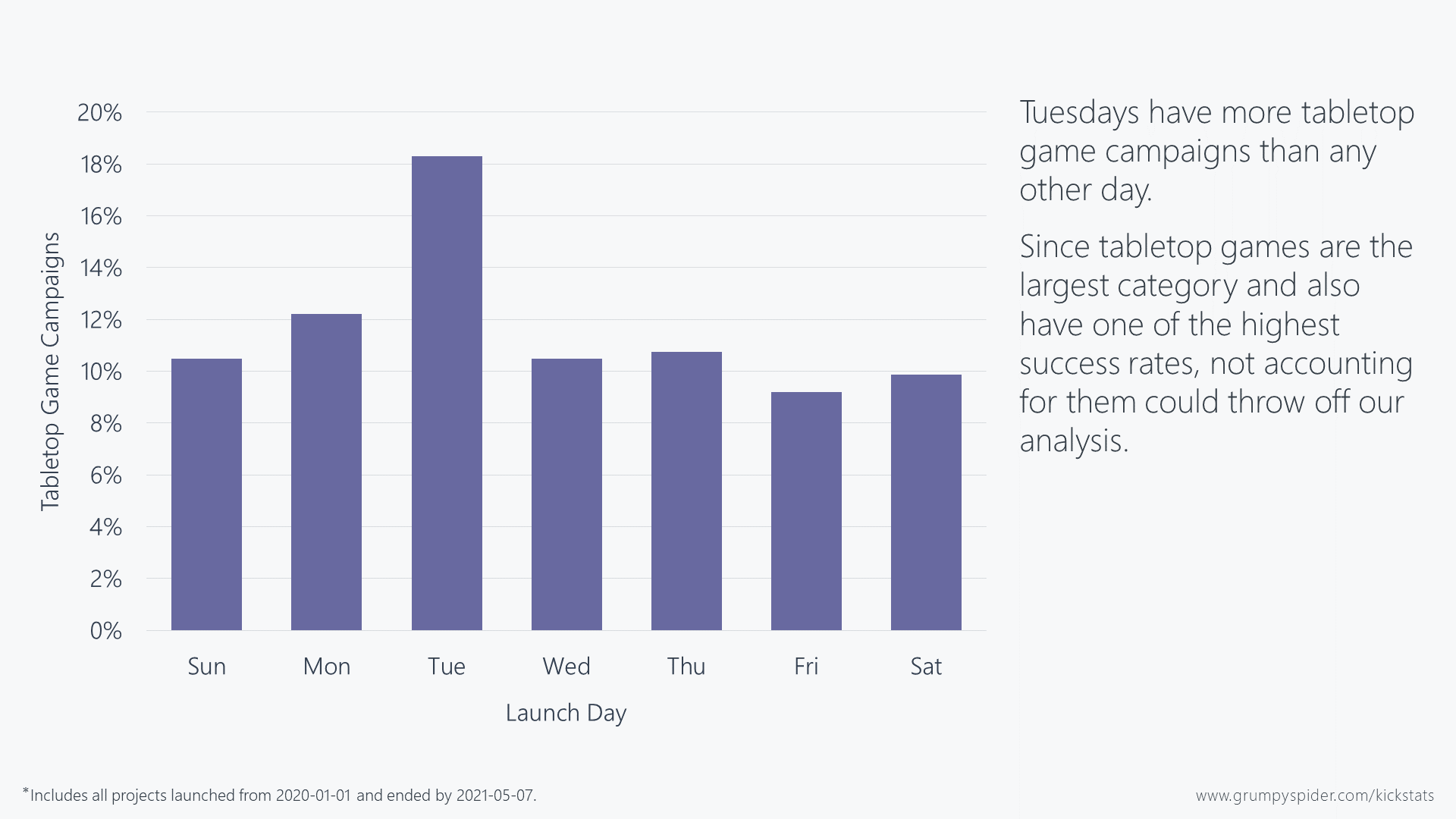
The last factor we’ll want to take a look at is one that hasn’t been mentioned much in our previous Kickstats articles, and that factor is the percentage of campaigns launching on a given day that are tabletop games. Two things we know about the Tabletop Games category are that it’s the largest category on Kickstarter and also one of the most successful. So if tabletop game creators happen to have a preference for launching on any particular day, that could easily skew our results.
Anyone familiar with the tabletop gaming space shouldn’t be surprised to find that Tuesday is, by far, the most popular day to launch tabletop games on Kickstarter. So we’ll definitely need to account for that as well.
Other Lurking Variables
Most likely, there are plenty of other lurking variables out there that I haven’t thought of or that we don’t have enough data to detect. A great example of the latter would be prelaunch marketing efforts, which definitely have a major impact on success, but are particularly difficult to track. For now, though, we’ll have to work with the data we have and the confounding variables we’ve discovered in it.
Results
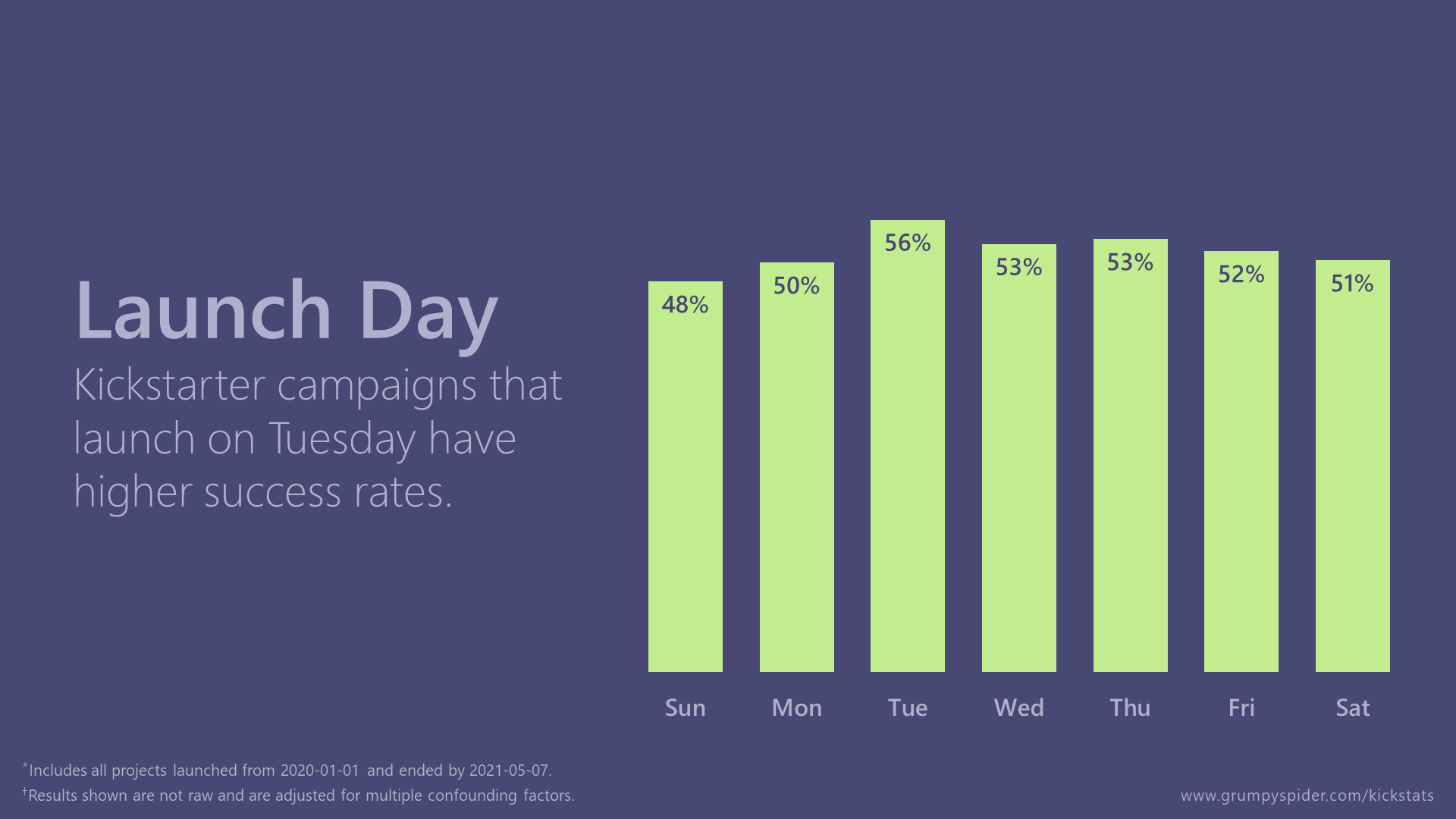
And now, the moment we’ve all been waiting for… What day of the week is the best day to launch a Kickstarter campaign?
I have to say, I’m a bit surprised by these results! I know for many people this is just confirmation of what you’ve known all along, but I was among the group that thought Tuesday’s success was entirely due to other factors. Even after adjusting for those other factors, though, Tuesday doesn’t give up its lead, although it is smaller than the raw data would suggest.
To be fair, there’s still a good chance that Tuesday’s success is largely due to a self-fulfilling prophecy. I mean, if all the big campaigns launch on Tuesday, then you’re conditioning a large number of backers to come to Kickstarter on Tuesdays, where they just might find other campaigns they think are worth backing. An argument could be made that that could happen with any day of the week, and Tuesday just ended up being the day that was chosen.
Whatever the reason, though, it doesn’t take away from the fact that Tuesday really does seem to be the best day to launch on Kickstarter.
What are your thoughts?
Did these results surprise you? Are there important factors that you think I may not have considered? Let me know in the comments!
This article now includes all Kickstarter campaigns that launched in 2020. The significant increase in sample sizes has resulted in minor changes to the outcome of our original analysis. Portions of this article have been rewritten to reflect those changes.
Introduction
We all suspect (i.e. basically know) that location has an impact on the outcome of a campaign. There’s just no two ways about it – if you live in the US, your campaign has a higher chance of succeeding simply because most backers come from the US, right? Well you might just be surprised by the answer.
Hypothesis
If I had to guess, I’d say the US will have the highest success rate, though not by much. Why do I think that? Well, because like I mentioned before, the US has the most backers by far. When you think about international shipping costs, it makes sense that most US backers will be more likely to back US-based projects as opposed to international ones. Of course, this is just a hunch. Let’s see if there’s anything to it.
Analysis
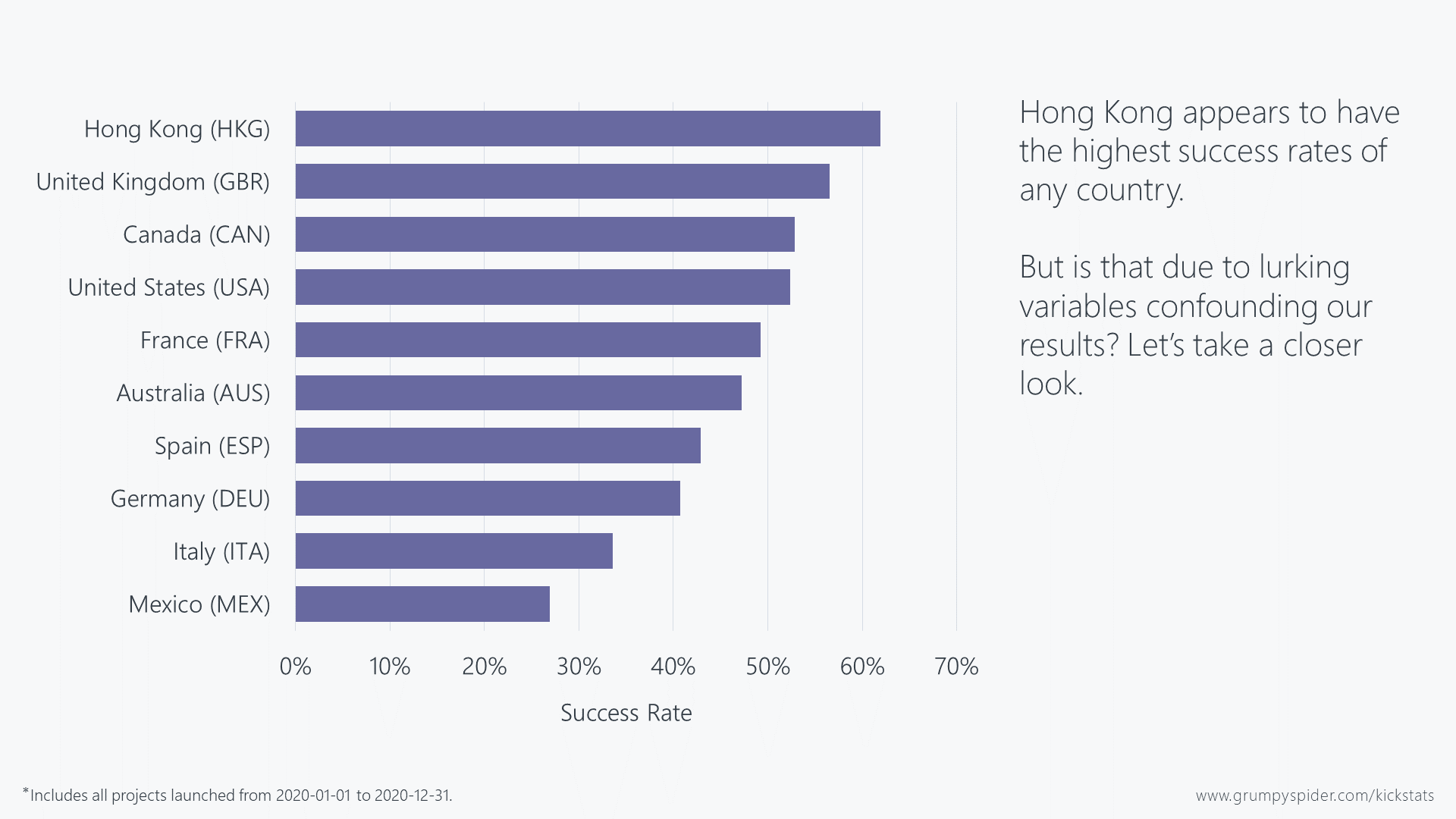
First, let’s take a look at the top 10 most popular countries on Kickstarter based on the number of projects launched. We’ll use these as the scope of our analysis. Below is a chart showing the raw success rates of those countries.
As it turns out, my hunch may have been unfounded. So far, the United States looks to be the fourth most successful country. It’s Hong Kong that takes first place with the highest raw success rates.
Lurking Variables
If you’ve read some of the other posts in this series, you know I spend a lot of time thinking about the sneakiness of lurking variables. In this case, we’ll definitely want to spend some time taking a look at those.
First-Time Creators
You might not think about different countries having different percentages of first-time creators, but I wouldn’t be terribly surprised if that were the case. If nothing else, I’d think the US has fewer first-time creators simply because Kickstarter started in the US, so creators have (theoretically) had more time to create more than one project. Let’s take a look.
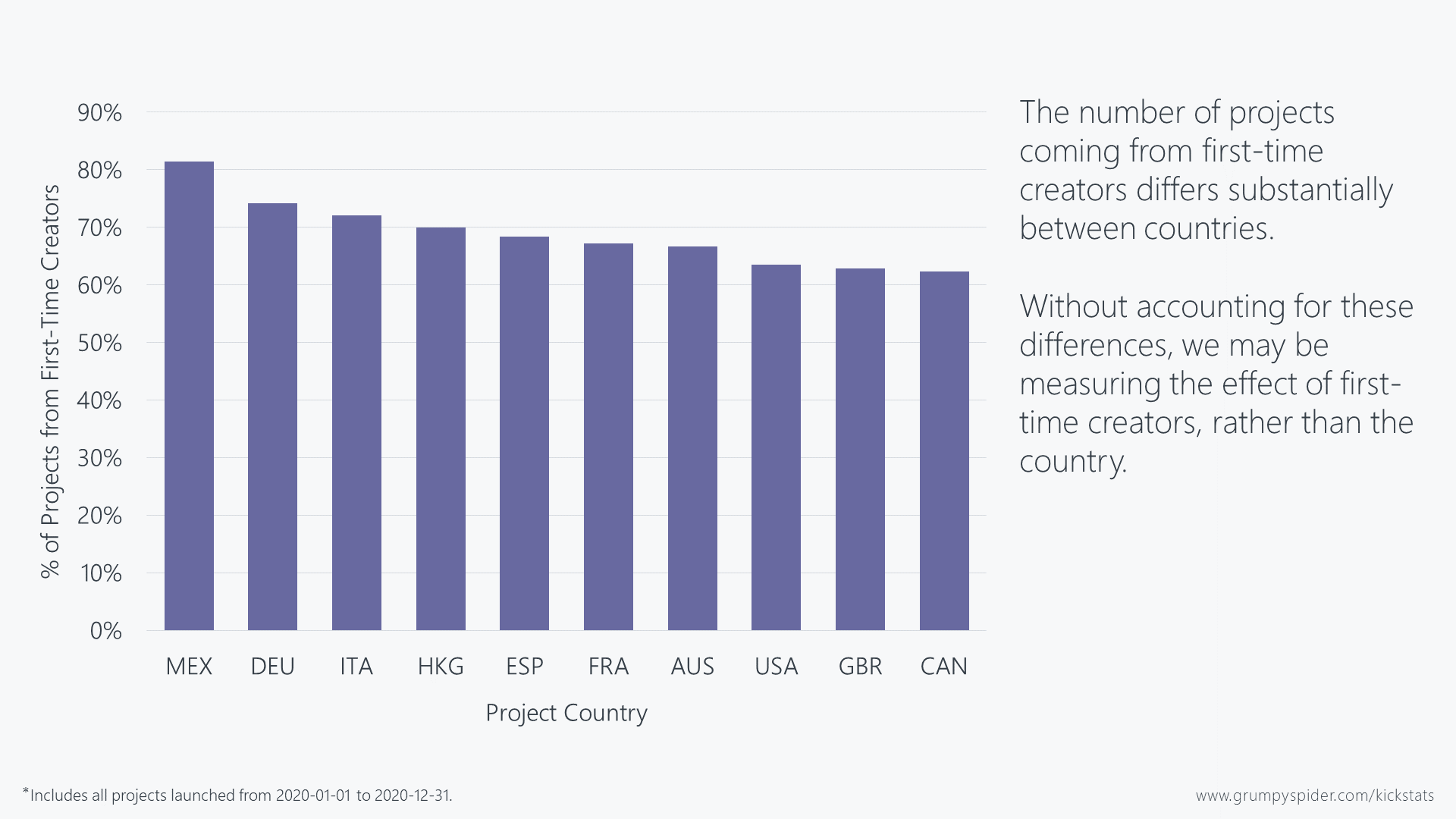
It turns out that different countries do actually have different percentages of first-time creators. The US is on the lower end, which tracks fairly well with my thinking. Mexico ends up having the most first-time creators, proportionally. I don’t know why that would be, but we should account for it either way.
Funding Goal
The cost of manufacturing can differ quite dramatically from country to country. One country having generally lower manufacturing costs than another could easily lead to less funding needed for a successful Kickstarter campaign. Since it’s no surprise that funding goal affects the probability of success, it’s definitely possible that a campaign’s country could be confounded with the funding goal.
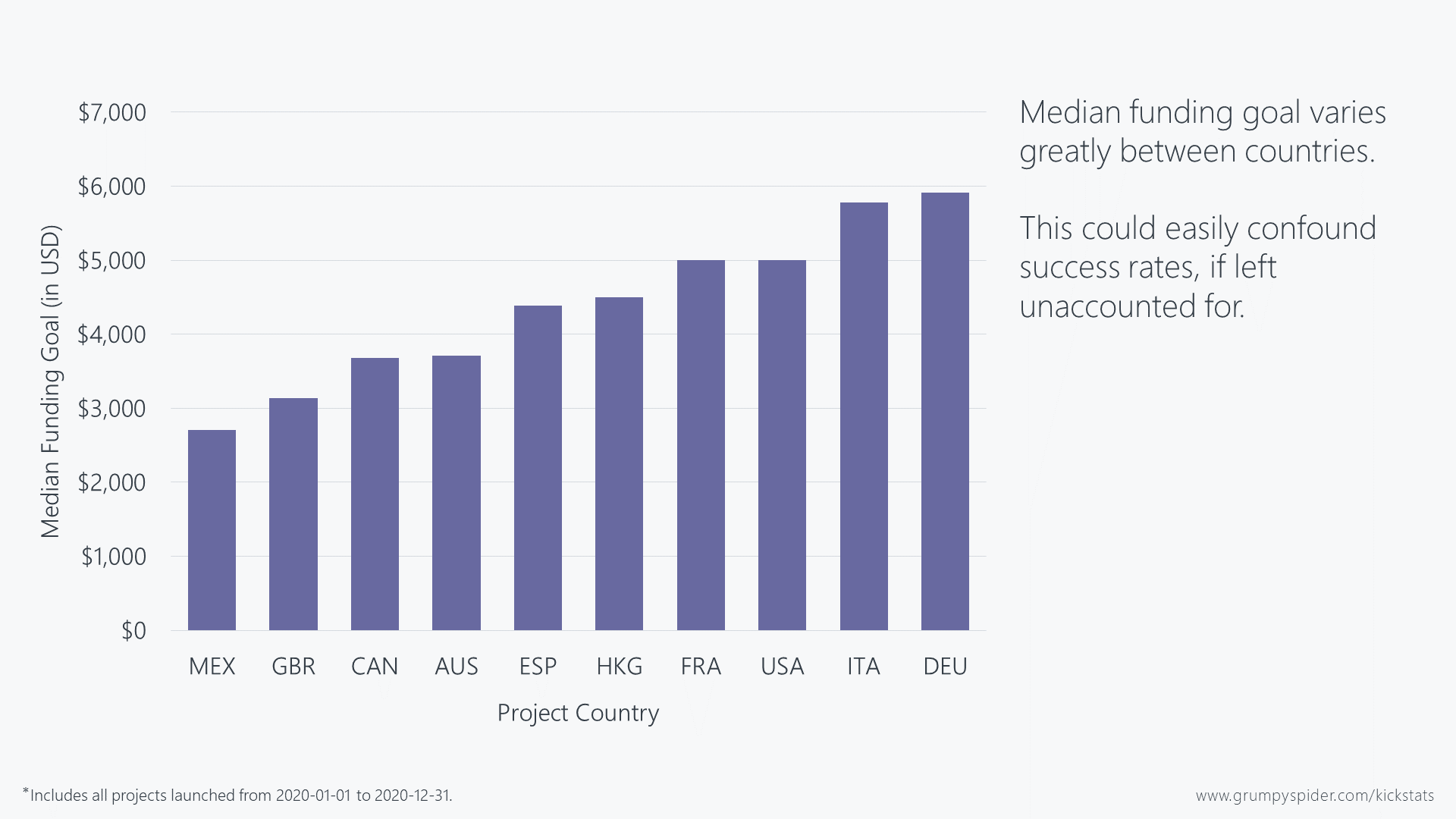
Well, there’s definitely a difference in median funding goals between countries. Germany and Italy’s are both more than twice that of Mexico’s! So, we’ll do what we can to account for that too.
Results
So which country has the best success rate? Take a look below.
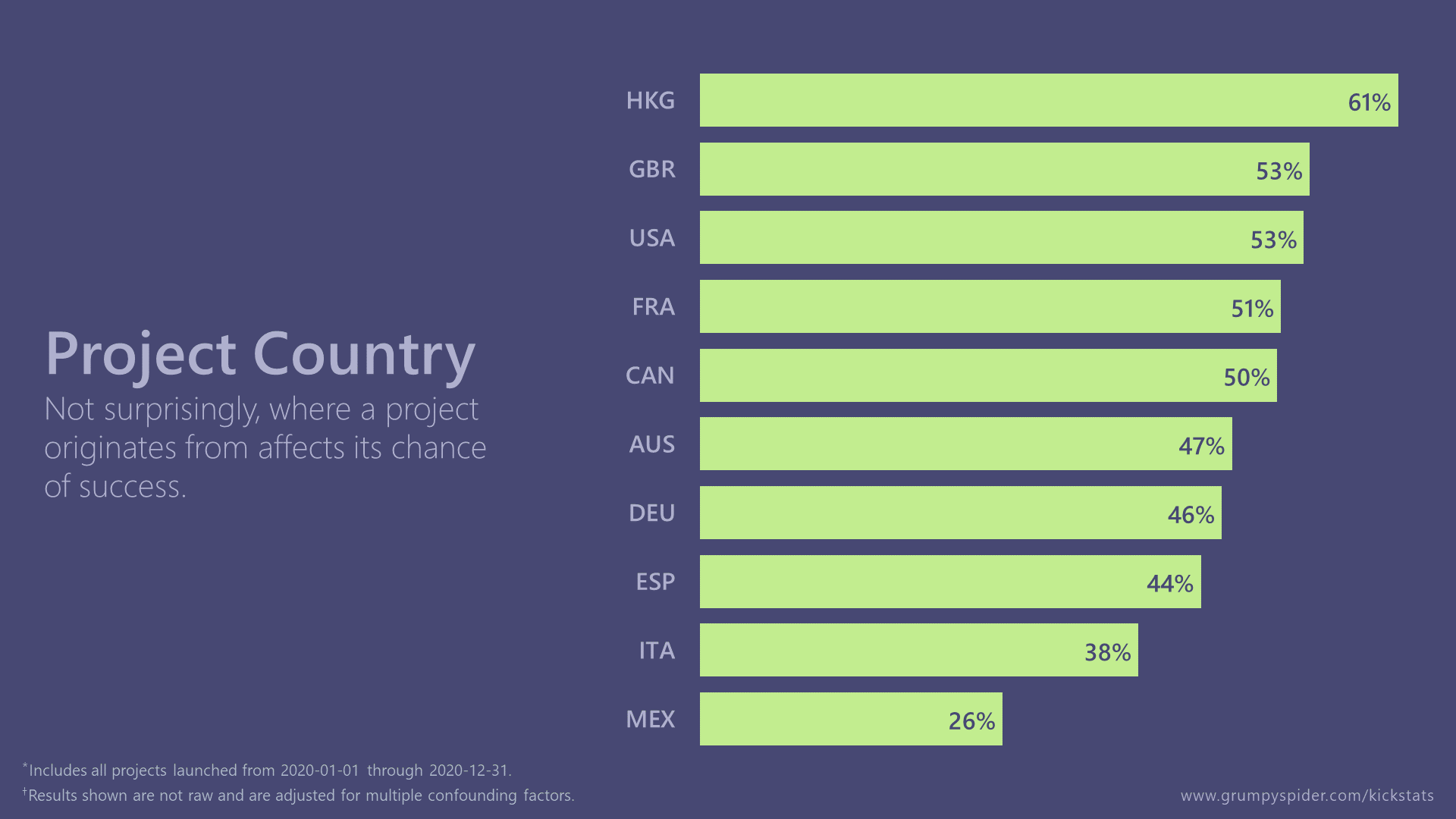
A few of the countries shuffled around a bit, but for the most part, the final results aren’t a whole lot different from the raw results. This shows that the reason a country has higher or lower success rates has very little to do with funding goal or distribution of first-time creators. There are other – more important – factors involved here.
To that effect, Hong Kong still holds the #1 spot by a fairly decent margin. Likewise, Mexico still takes last place by an even larger margin. It makes me wonder about what might be causing that.
Conclusion
Why do you think Hong Kong seems to lead the pack for campaign success rates? Or why would Mexico be so much lower than the rest? Are there any other interesting questions to ask or conclusions to draw? Let me know in the comments!
One important piece to planning a Kickstarter campaign is predicting where your backers will likely come from. And I don’t mean what social media site – I mean what region of the world.
Why is It Important?
There are several reasons why it’s useful to know what countries your backers are coming from, but for a quick example, I’ll focus on shipping costs.
Since Kickstarter still counts shipping costs toward your overall funding goal (as of May 2020), not accounting for those costs can really mess up your finances. For instance, shipping a small card game within the US might cost around $8. Shipping that same game to Europe, however, will cost $23, nearly 3 times as much!
So let’s set up an example of how this might play out. For simplicity, let’s pretend that Kickstarter fees, payment processing fees, sales tax, marketing costs, etc don’t exist (what a wonderful world that would be!). You’ve done your homework and know it will cost $5,000 to manufacture your game. To reach that goal, you decide on a base pledge amount (the lowest pledge amount to get 1 copy of the game) of $20. At that price, you’ll need 250 backers to reach $5,000 in funding.
(250 backers) * ($20 pledge) = $5,000
But, you know that shipping is included when calculating your goal, so you increase it to $7,000.
So now you’re good to go, right? Not so fast – you’re assuming that shipping will be $8 no matter where you’re shipping to. What if 50 of your backers come from Europe? Setting your goal to $7,000 will make you $750 short!
The trouble is, you don’t know how many European backers you’ll get, and then of course you have to think about backers from Canada, Japan, Australia, etc, and all of these places have different shipping costs! If you don’t at least have a reasonable estimate of this distribution you could overestimate, making your funding goal too high, or even worse, make it too low and possibly not be able to fulfill.
That’s just one reason why it’s crucial to get a good estimate for where your backers will come from.
Where Do Backers Come From?
The best way to estimate where your backers will come from is to look at other projects that are similar to yours. That information can be found in the “Community” tab of any finished campaign that had at least 10 backers. Of course, it can be tedious to do all that, so I’d like to help you out by at least giving you a general idea. Here’s a quick breakdown of where backers come from for all Kickstarter campaigns that launched and finished year-to-date (about 6800 projects).
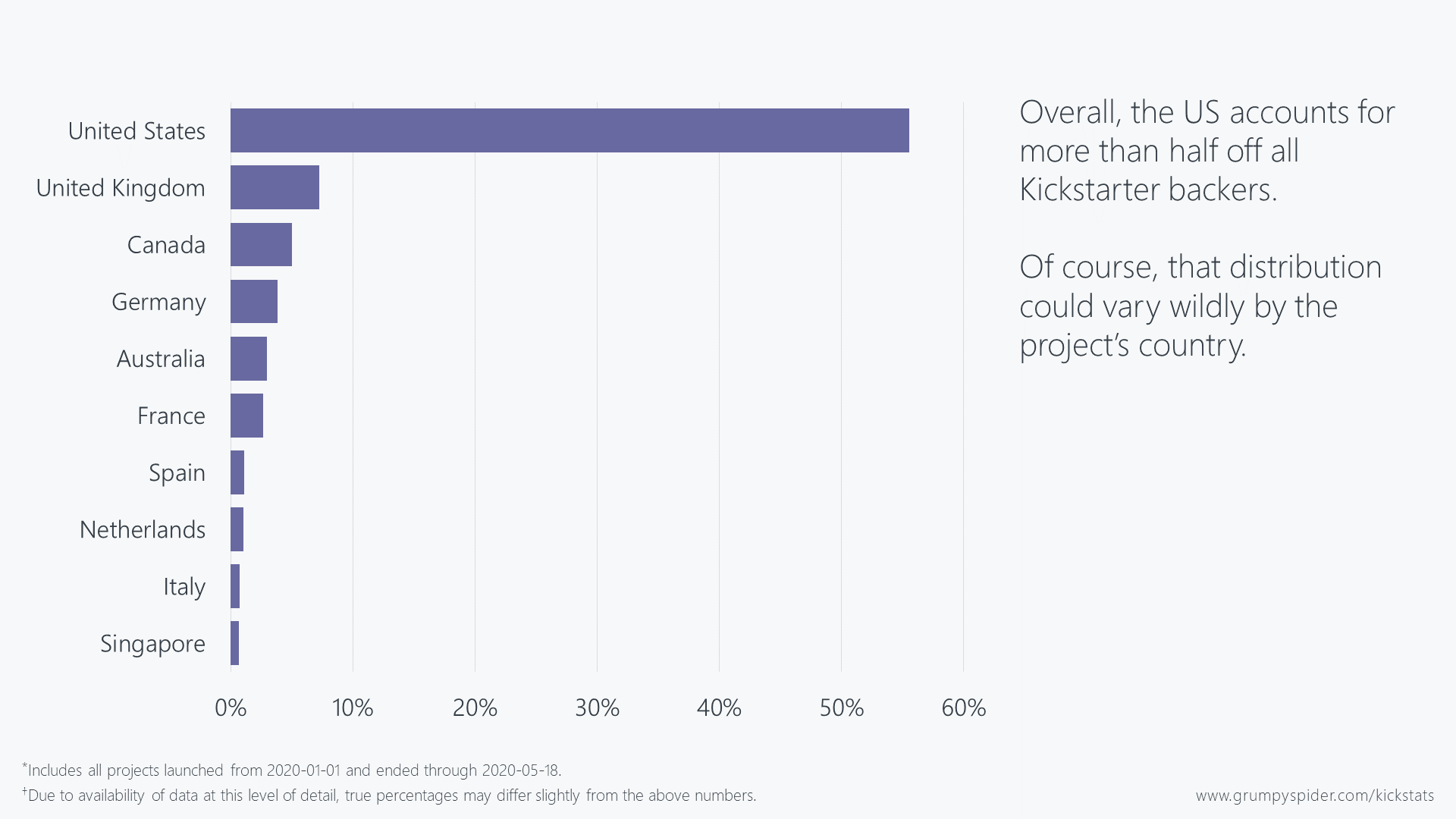
From the above chart we can see that, on the whole, the US makes up the vast majority of backers. That percentage, however, is likely to vary quite widely based on the country of the project itself.
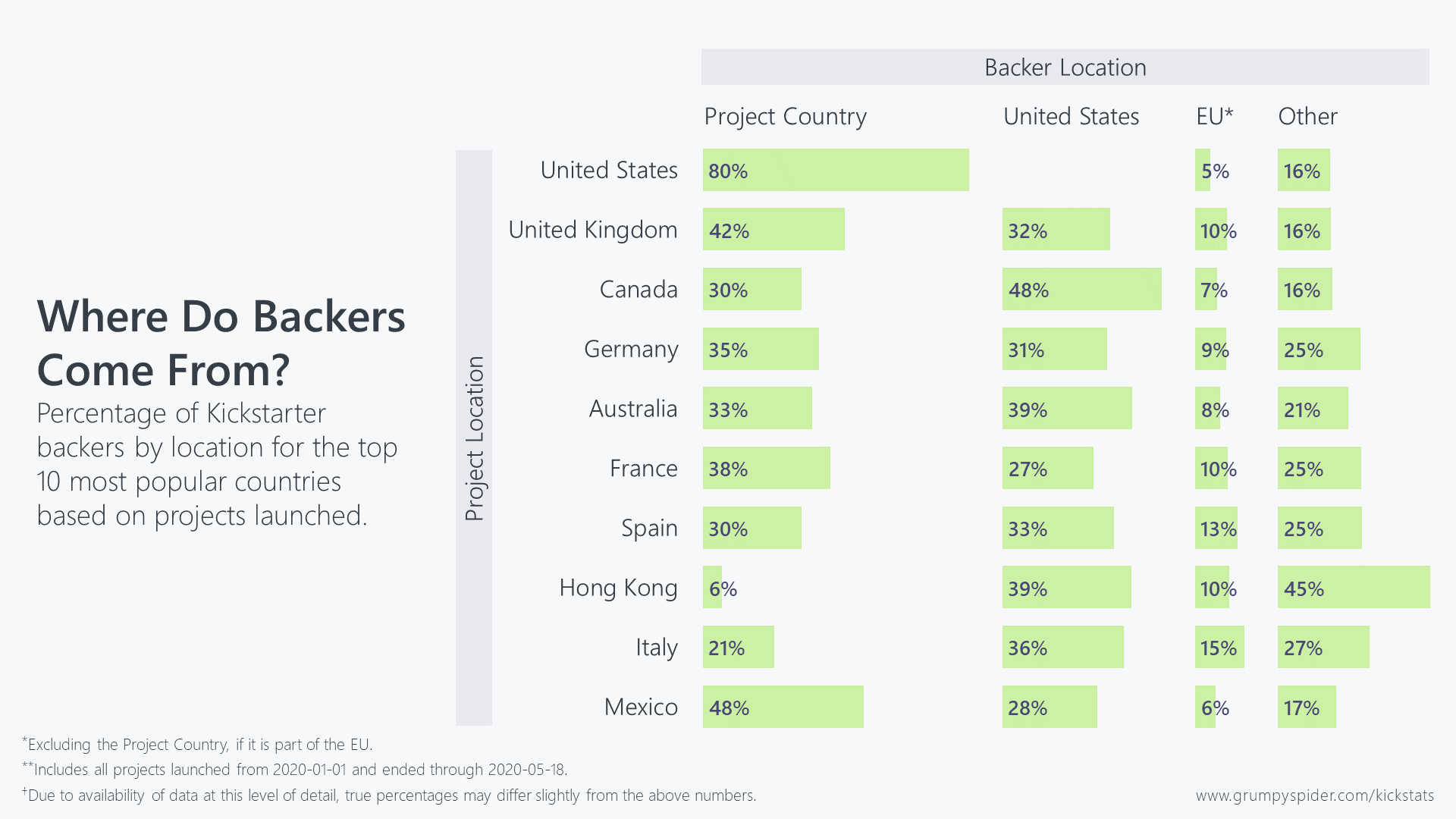
To help get a bit more accurate numbers, let’s break out backer counts by project country. Below is a chart showing percentage of backers by region for the top 10 most popular countries based on projects launched.
I’m Using a Distributor and/or Pledge Manager
After reading all this, you might be thinking “I’ll be using a global distributor and/or a pledge manager, so this doesn’t really apply to me.” Well, that may be true for shipping, since you can charge it separately from the original Kickstarter goal, but there are other reasons why predicting the locations of backers could be useful. For instance, what time of the day you should launch, what day of the week you should launch, or knowing what holidays to avoid are very likely dependent on what part of the world your backers are coming from. If you get a good grasp on this, then you’re already ahead of the game.
Board games aren’t my only hobby. In fact, one of my biggest hobbies is creating things in general. That naturally leads me to a love for designing board games, but I also occasionally make board-game-related things, which I’d like to share with you now!
I’ll probably add more as things pop into my head. If you have any requests, feel free to comment below.
Hex Board Generator
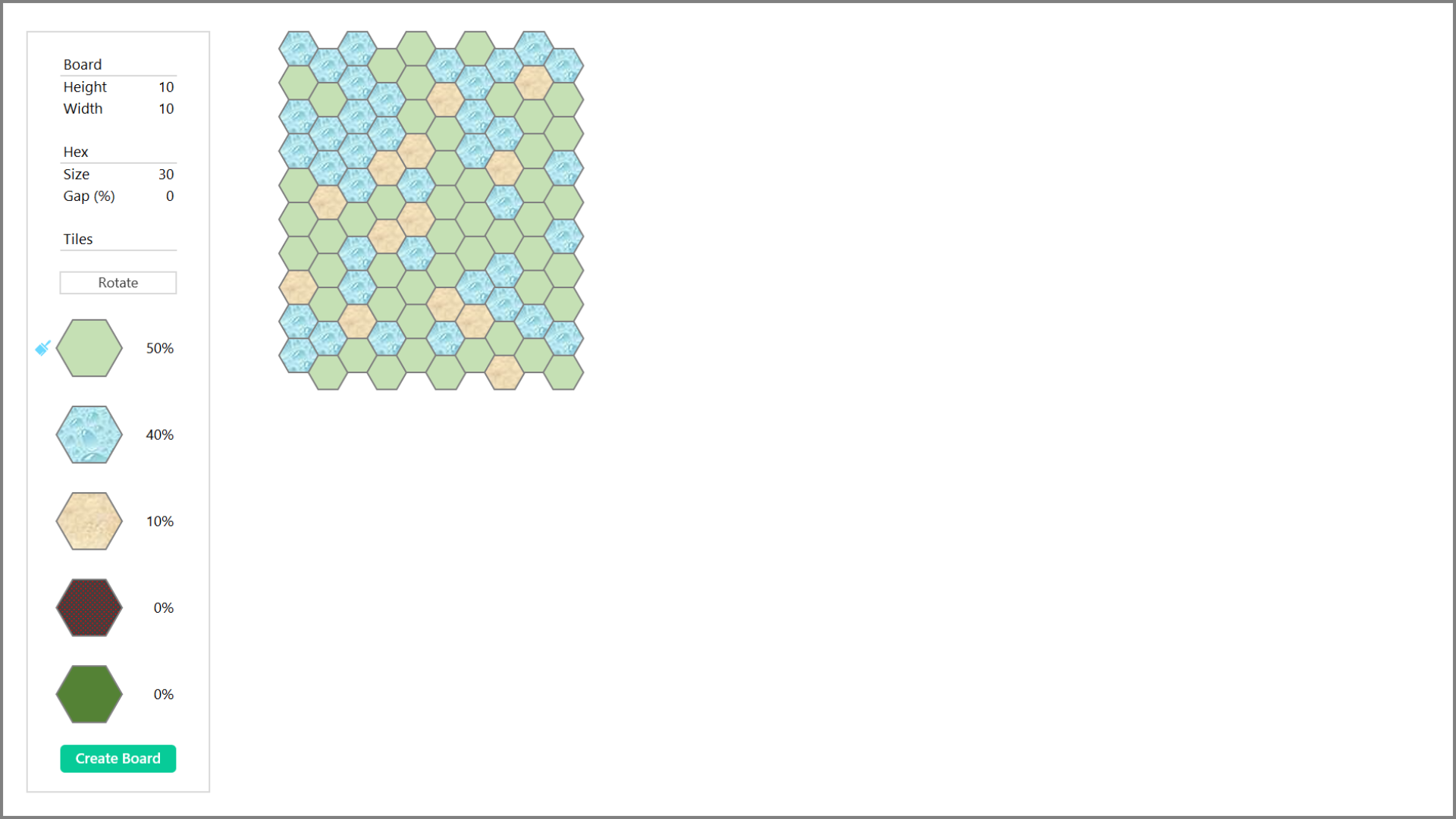
The Hex Tile Board Generator is something I created in Excel recently. As the name implies, it lets you create hex boards quickly, which you can then print off and use however you need. Here are a few things you can do with it:
Edit the look and feel of up to 5 pre-defined tiles
Set the width and height of the board
Set the size of the tiles
Set the size of the gap between tiles (including having no gap at all)
Rotate the tiles to the horizontal or vertical position
Randomly generate tiles based on approximate percent chances
Quickly edit individual tiles after the board is created
PLEASE NOTE: When you click on the link above, it will look like a Google Sheets file, but it is not one. The generator only works as a macro-enabled Excel workbook. To use as one:
Click the link above
Navigate to File > Download > Microsoft Excel (.xlsm)
Open the downloaded file in your desktop version of Excel
If you’ve read the other posts in this series, you may have asked, “Why go through all the trouble of collecting this data? Why not just ask what potential backers want?”
Well, there are a couple of reasons for preferring hard data over surveys. Let’s go over a few of them.
The Case for Hard Data
Response Rates
Getting people to respond to survey’s can be difficult. Personally, my usual channel is Twitter and/or Reddit. So far, the highest number of responses I’ve gotten to any question I’ve asked has been about 10 people maybe, and that’s just not a lot of info to work with. To be honest, even if I got a phenomenal number of responses, it would still pale in comparison to the literal thousands of projects that I can analyze on Kickstarter.
Surveys Can’t Answer Everything
If I surveyed 100 people, and asked them “What’s the best month to launch a Kickstarter campaign?”, most answers would probably congregate around 6 different months or so. Sure, most would say December isn’t a good time to launch, but what about August? Or March? That’s a bit harder to know, and can really only be answered by analyzing the hard data.
Stated vs Revealed Preference
There’s often a real and measurable difference between what people care about and what they saythey care about. For example, people may say they like blue boxes better than red, but if you measure their actions, you may find that red boxes are actually bought more often. Or, to give a real life example, someone may say that data privacy matters… until they’re offered some pizza.
This disconnect could easily affect Kickstarter as well. For instance, when you ask backers about shipping, usually the majority say they prefer to have shipping “baked in” to the overall price, instead of added separately. But what if doing that takes the price of your game from $30 to $42? That might start triggering the “sticker shock” reaction and actually cause people to not pledge. Even though $30 + $12 shipping = $42, seeing the $42 all at once can definitely have an effect.
That might seem odd, but the human mind is sometimes an odd thing. This, of course, was just a made up example. Usually, the disconnect is a little more subtle than that, but it is definitely there. Because of that disconnect, measuring actions is often better than measuring opinions.
The Case for Surveys
Don’t get me wrong, surveys are still incredibly useful and are sometimes vastly superior to hard data. One of their biggest advantages is their ease of access. What might take months or even years of effort to gather through other approaches could be a single question on a survey.
For instance, if I wanted to know the most popular color in America, there are a number of hard data points I could use to guess it. In theory, I could broker a deal with credit card companies to get everyone’s purchase history and scan it for the colors of the clothes and bath towels they buy. I could use google maps to collect the color of everyone’s house. I might even be able to access a vehicle purchasing database to see what color car everyone owns.
Well, not only would that be super creepy, it would also be super difficult. Why not just ask you what your favorite color is?
When playing board games, what’s your preferred player color?
This article now includes all Kickstarter campaigns that launched in 2020. The significant increase in sample sizes has resulted in moderate changes to the outcome of our original analysis. Portions of this article have been rewritten to reflect those changes.
A few months ago, a Twitter friend of mine made an interesting statement:
Kickstarter pet peeve #39: creator’s not making their profile public . I’ll back anyone that’s backed us but I can’t tell if you haven’t changed your default profile setting. =)
It got me thinking. Is that a common pet peeve? Are there other ways a private profile might hurt your chance of success? Does it affect anything enough to even be noticed?
Well, that’s what I’d like to find out in this post!
Arguments
On one hand, David makes a great point. A private profile blocks other Kickstarter users from seeing what projects you’ve backed. If another creator wants to return the favor and back your project, having a private profile makes it much more difficult to verify that you actually did back their campaign.
Private profiles also give the impression that you either (a) haven’t really done your Kickstarter homework to realize that your profile is private by default, or (b) don’t really care about being a transparent creator. And if there are two things that Kickstarter backers value above all else, it’s transparency and homework. Now, is it always true that private profiles mean a lack of planning and transparency? Of course not, but you have to admit those assumptions are understandable.
On the other hand, private profiles still let others see how many projects you’ve backed, even if they can’t see what they are. So as long as you’ve backed at least a few campaigns, you should remove any negative effects of looking too self-centered. Maybe that’s enough to counteract the negative effects of a private profile as a whole.
Analysis
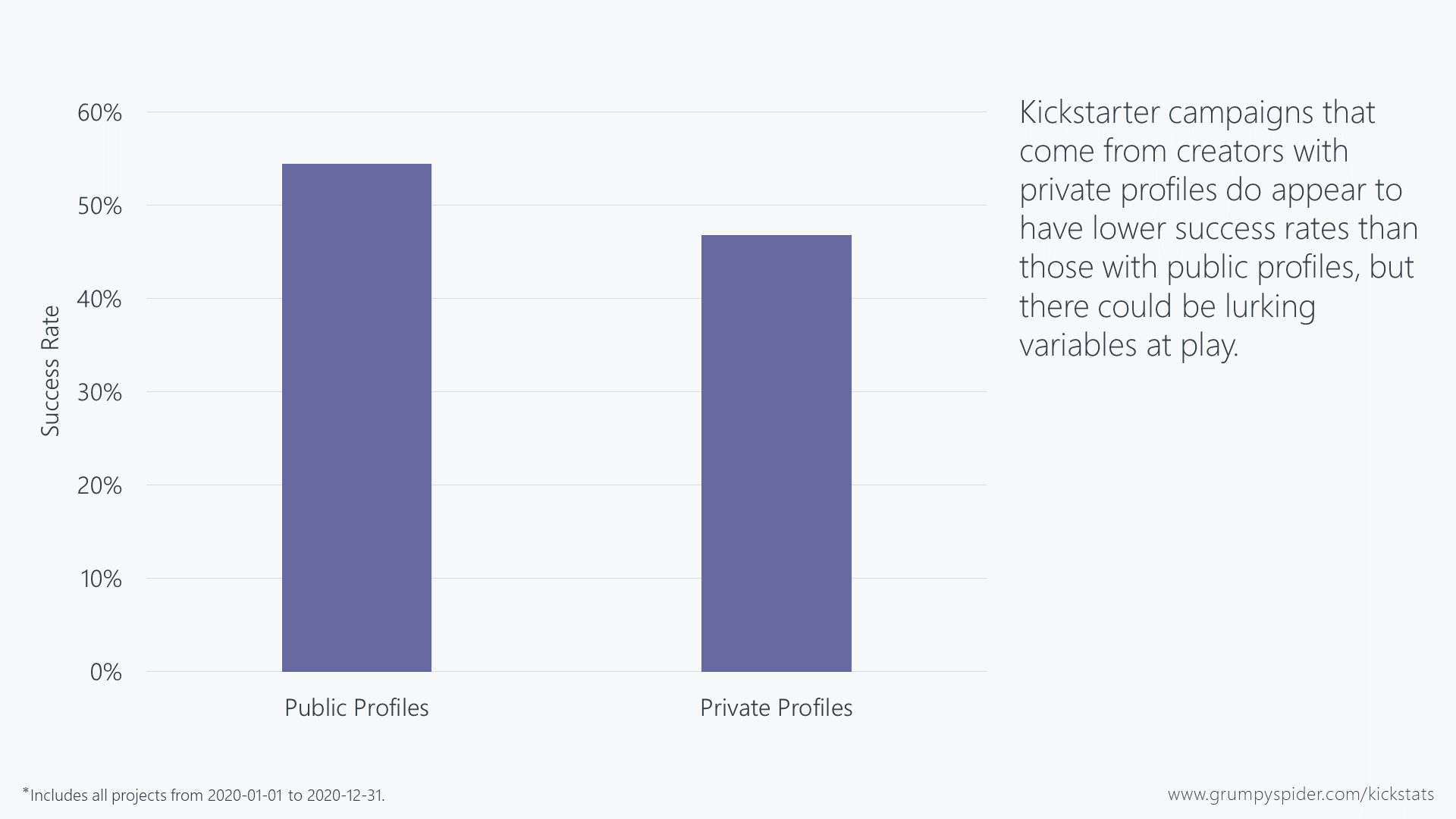
Thankfully, it’s pretty straightforward to separate campaigns by the creator’s profile being public or private when they launched. There’s not really a lot of extra explaining to do with this one, so lets get right into graphing the raw numbers.
So it does appear that creators with private profiles do worse on average than their public counterparts. Before we end there, however, we still need to look at a couple of possible lurking variables that could be confounding these results.
First-time Creators
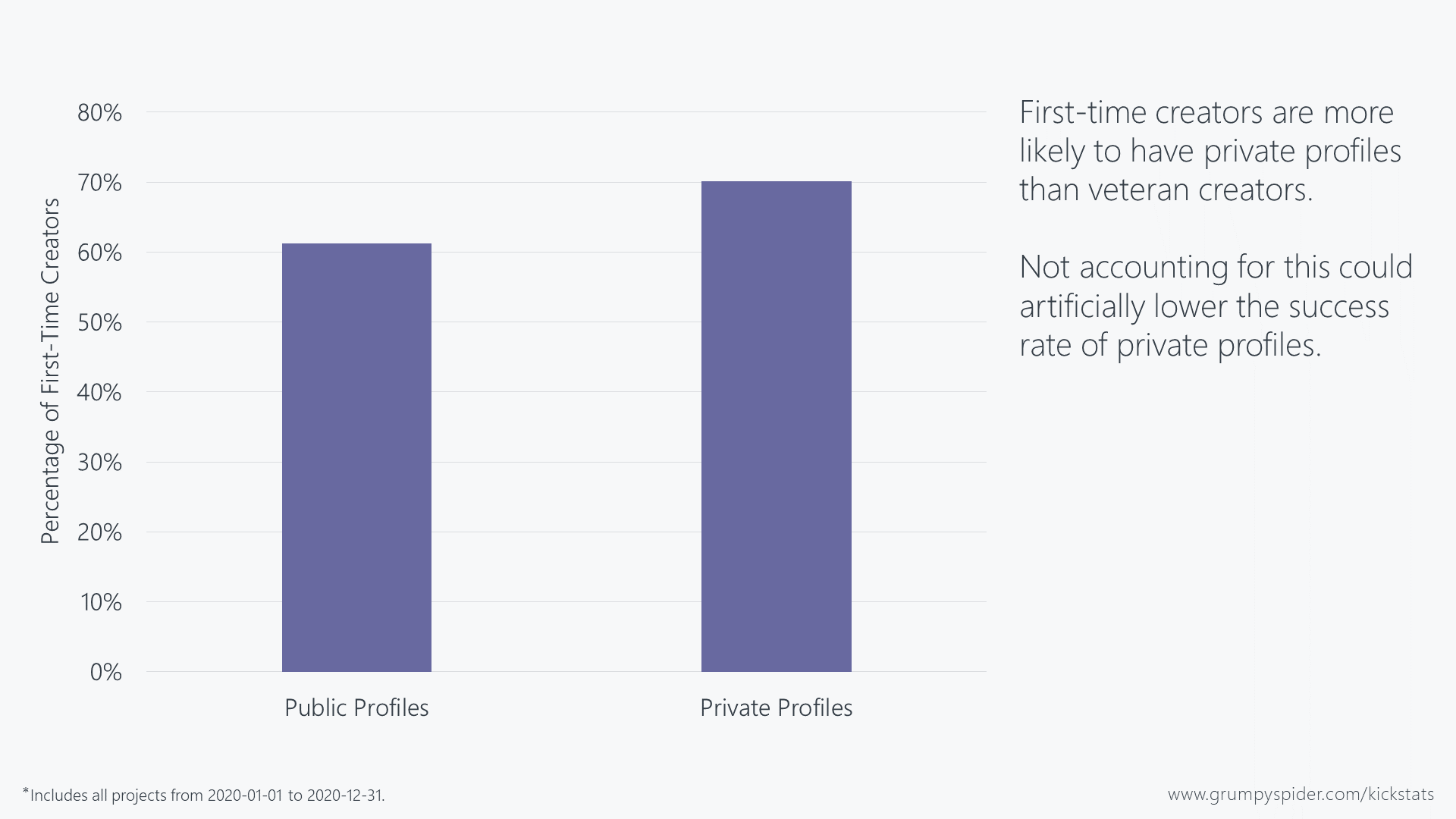
We’ve already shown that the number of projects you’ve launched affects your current campaign’s chance of success. What I’m willing to bet here, though, is that first-time creators are also more likely to have private profiles. If that’s true, then that means being a first-time creator is linked to both success rates and profile privacy, which makes it a potential lurking variable.
The difference here seems big enough to justify balancing on creator experience levels. So let’s do that.
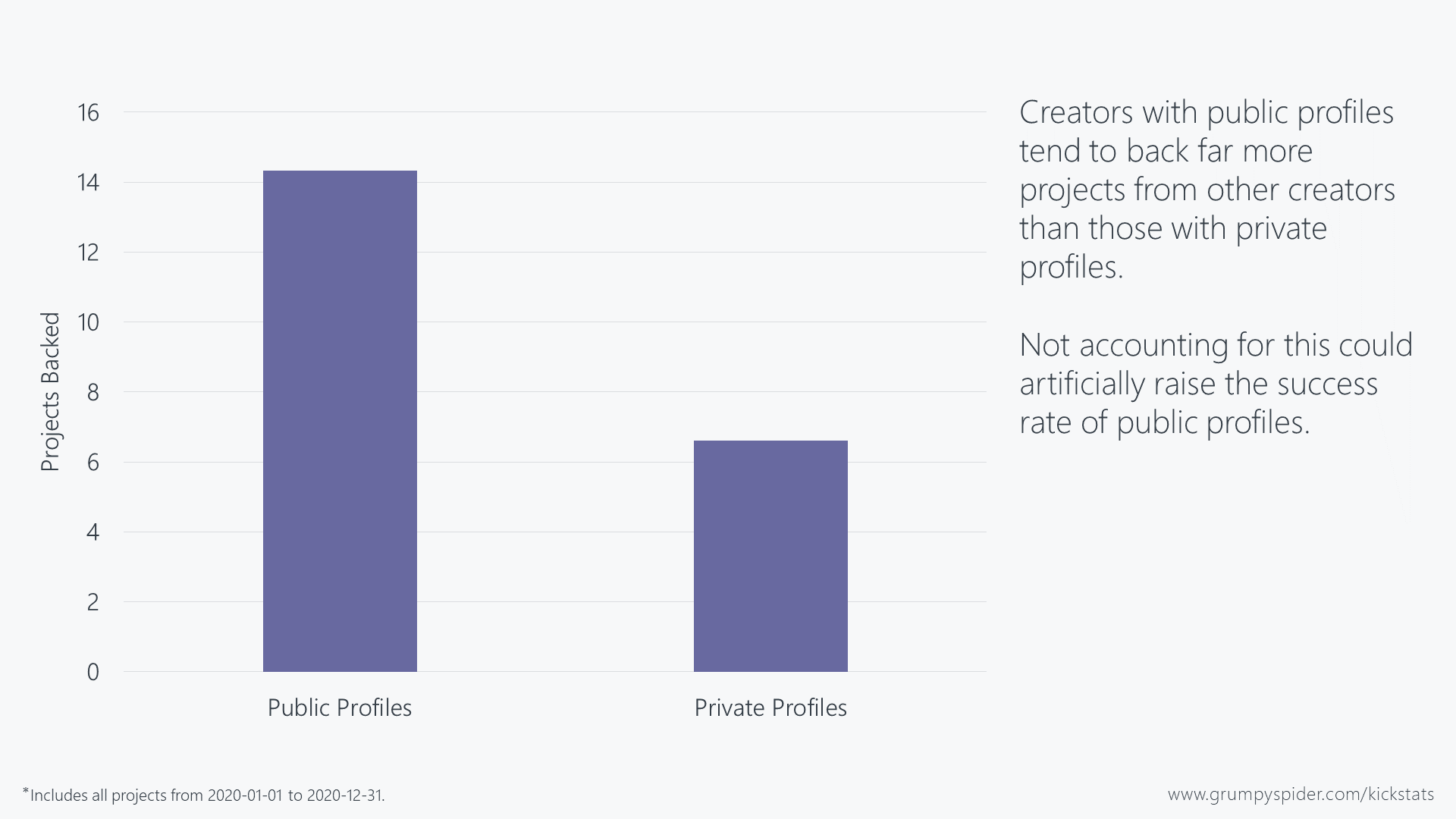
I’d say it’s quite likely that private profiles back far fewer projects on average than public profiles. Why? Well, if I had to guess, I’d say it boils down to a lack of community. Kickstarter profiles are private by default. If a creator doesn’t see the value of a public profile, then they might not be too concerned with making connections with other people in general, and thus would back fewer projects. Are there plenty of other factors going on? Certainly, but I’d say that’s a big one.
The best way to see if there’s any correlation between private profiles and number of projects backed is just to graph it. So let’s see if my prediction is correct.
That looks like a pretty obvious connection to me. Just knowing if a Kickstarter profile is public or private is a good indicator of how many projects they’ve backed.
Since the number of projects backed is linked to profile privacy and also linked to success rates, that means that the number of projects backed could be confounding the effects that profile privacy has on success. So, we’ll have to remove that confounding as well.
Results
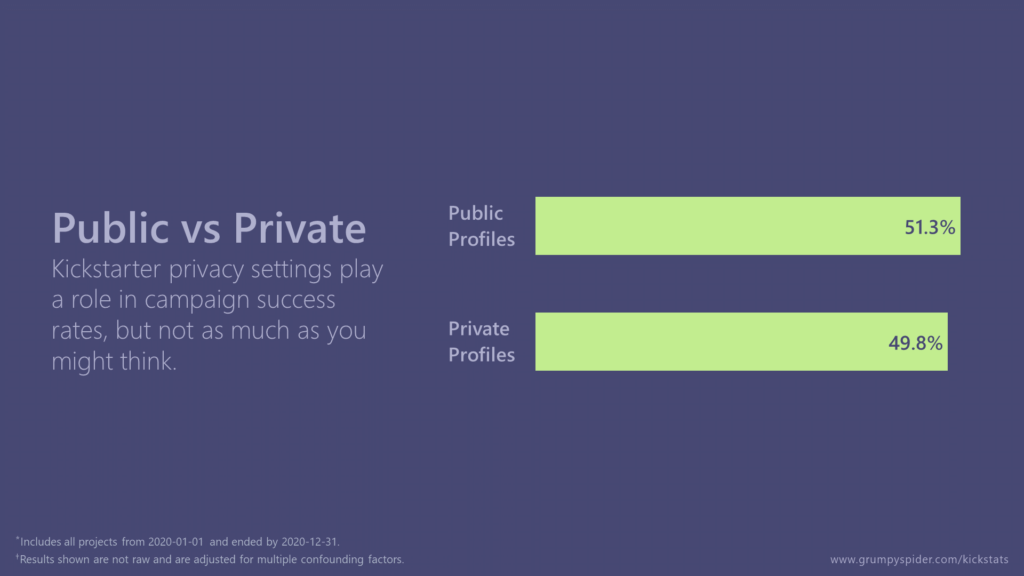
After adjusting for the above two factors, we can now say with reasonable confidence just how much having a private profile affects your campaign’s success.
Conclusion
I figured private profiles would hurt your chance of success, but after accounting for first-time creators and the number of projects you’ve backed, the performance gap drops pretty substantially. However, even though a 1.5 point gap is certainly less than the original 7.7, I still wouldn’t consider it negligible.
Kickstarter backers value transparency. You may have done your homework, designed a great product, and created a killer campaign page, but if switching your profile to public gives potential backers just a little more confidence in you, why not do it?
This article now includes all Kickstarter campaigns that launched in 2020. The significant increase in sample sizes has resulted in minor changes to the outcome of our original analysis. Portions of this article have been rewritten to reflect those changes.
Common sense tells us that backing other projects on Kickstarter will help get your own campaign funded. It’s true that the people you back might return the favor, but that’s not the important part. What’s really important is that it shows others you’re not focused entirely on yourself. I know that I, personally, most enjoy helping those who help others. I imagine I’m not the only one who feels that way either. On top of that, it also gives you valuable experience with what it’s like to be a backer, which I believe many people consider before deciding on whether or not to back a campaign on Kickstarter.
Because of all that, I’m certain that backing other Kickstarter projects does affect things, but the question is “by how much?”. Does backing other projects affect a campaign’s success enough to make a tangible difference?
Hypothesis
My personal guess is that backing other projects is one of the best “tweaks” you can make to a Kickstarter campaign. I expect it to be even greater than what day of the week you launch, or even the time of year you launch. I also feel like the effect of backing other projects starts to level off after about four campaigns or so. Don’t ask me why I think that last part, though – it’s just a hunch!
Analysis
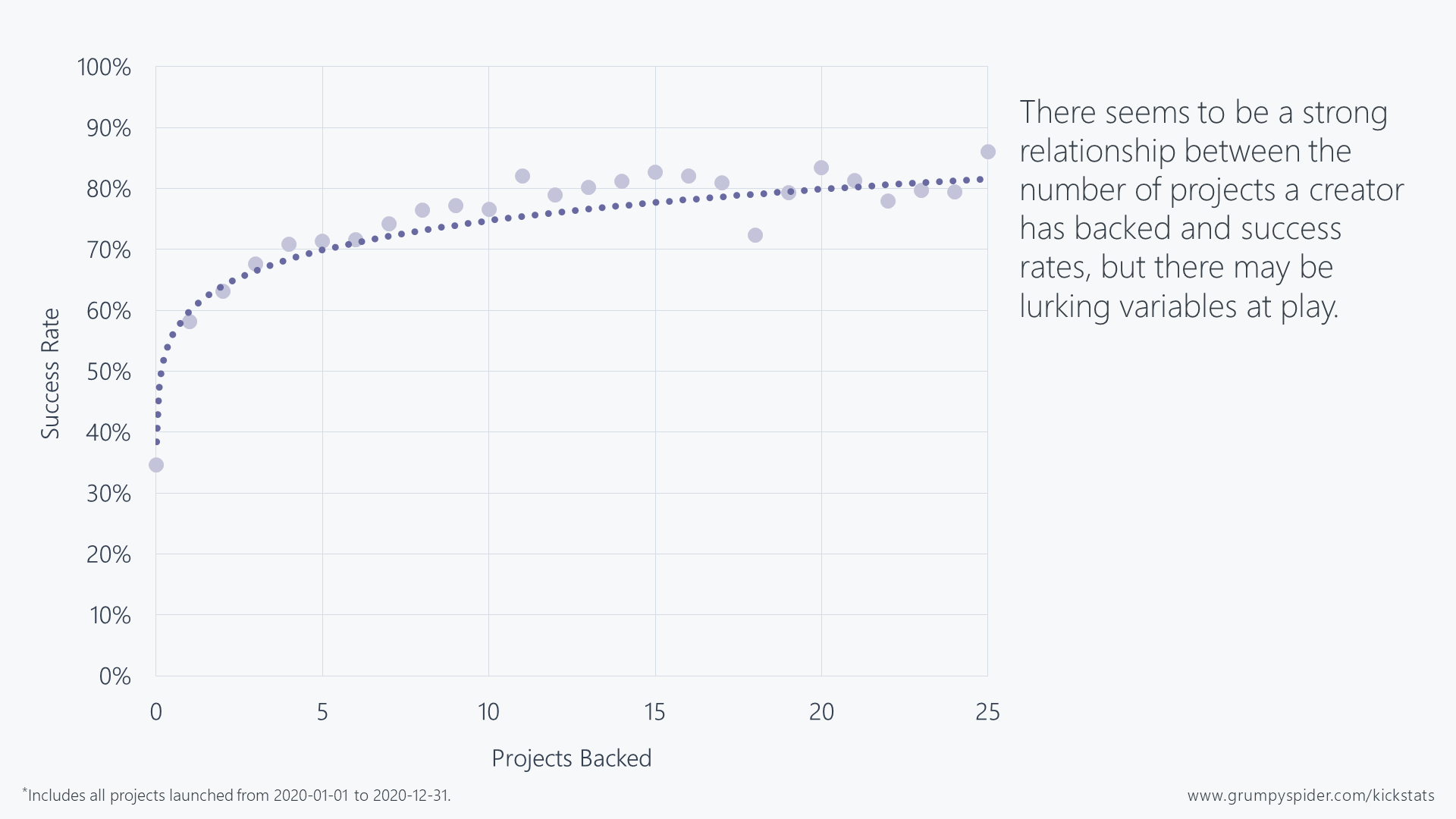
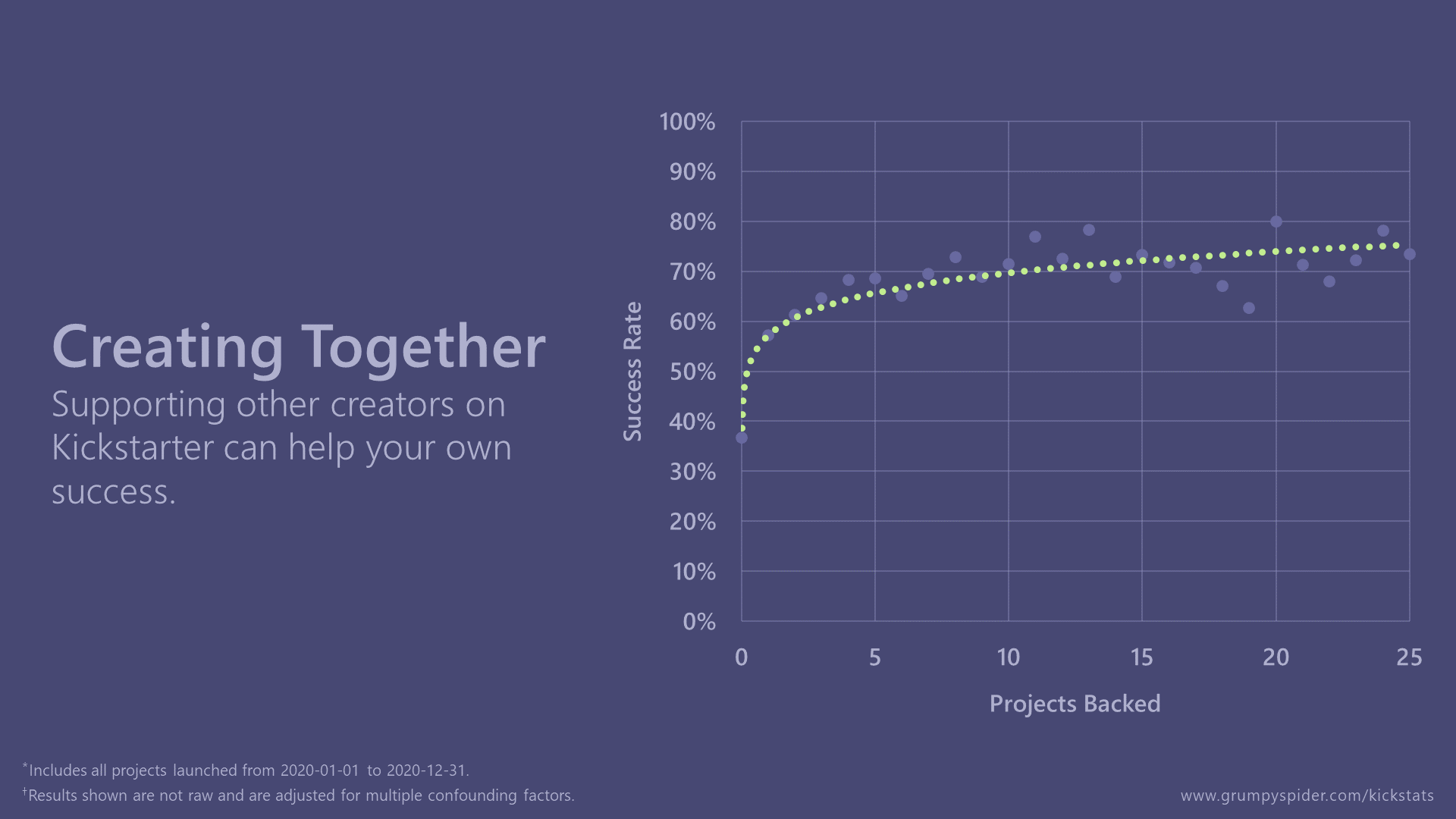
As usual, let’s start with a simple trend line showing campaign success rates versus the number of projects the creator has backed at the time their respective campaigns launched. Each point here represents multiple campaigns that all had the same number of projects backed.
As expected, this is a fairly strong correlation. Notice, however, that I didn’t say causation. Before we can start suggesting causation, we need to look at a couple of possible lurking variables.
First-time Creators
If I were a betting man, I’d be willing to wager quite a bit that there’s a strong link between first-time creators and number of projects backed. If nothing else, veteran creators have probably been using Kickstarter longer and, as a side-effect, have seen more projects that they’ve felt are worth backing.
I also think there are far too many first-time creators out there who know very little about Kickstarter other than “Hey, free money!”. Creators like that typically have very little interest in finding a community to support.
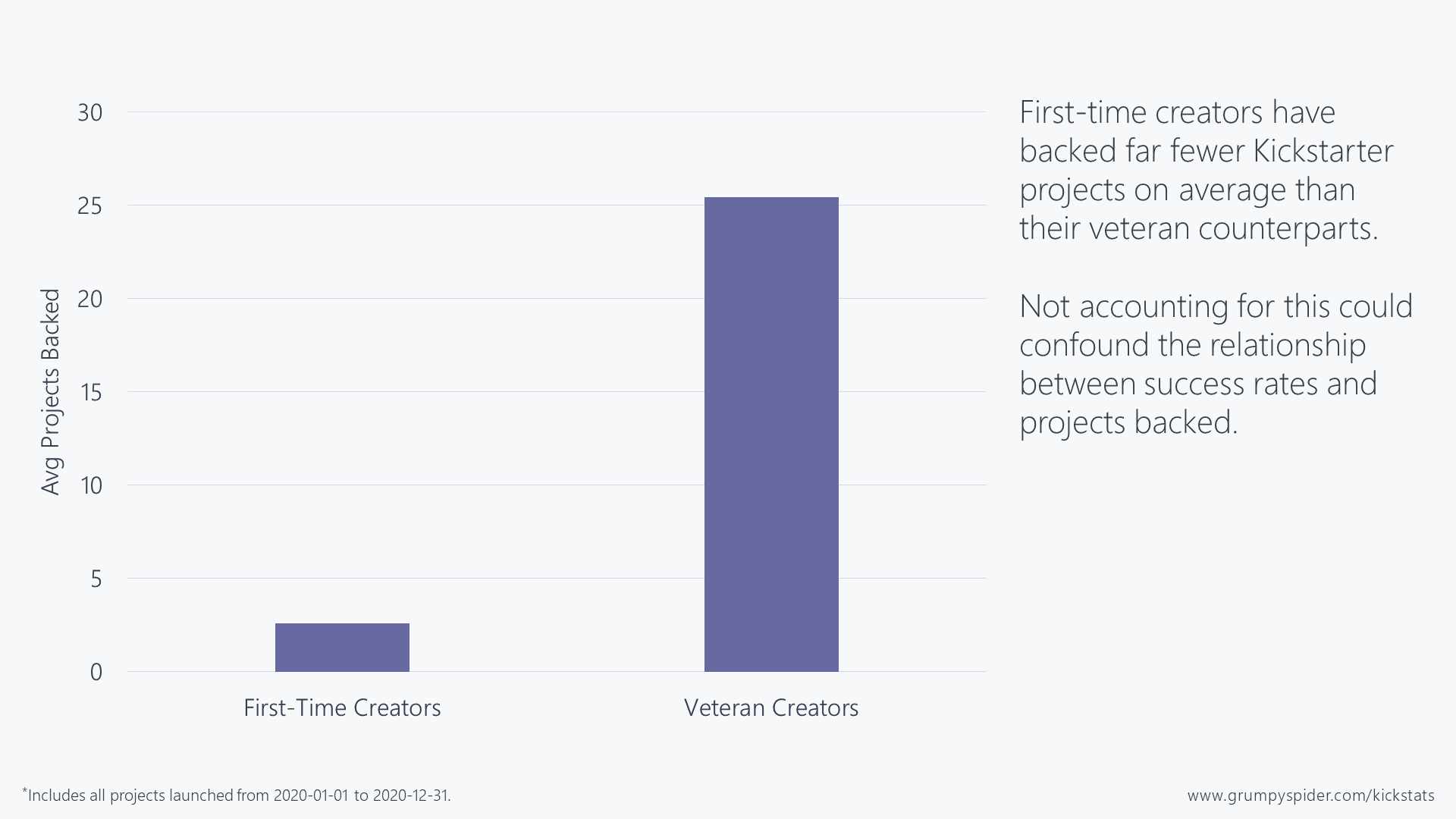
But enough of my reasoning, let’s graph it to see if I’m right.
Holy moly! That might be the most right I’ve ever been in my entire life! First-time Kickstarter creators, on average, back 2.6 projects by the time they launch their first campaign. Veteran creators, on the other hand, back a whopping 25.4 projects by the time they launch their respective campaigns!
All of this adjusting stuff can get really boring really fast, so I’ll just skip the explanation and jump to the results! How does the number of projects you back affect your chance of success? The below chart shows you just that!
Remember when I predicted that the effects would taper off after four projects? Turns out I wasn’t terribly far off. Success rates jump a full 20 points from zero to one projects backed! From there, they continue to go up, but by increasingly lower amounts until around five projects or so. After that, any gains seen start to become pretty negligible.
On a side note, you may notice that this final graph doesn’t look much different from the first graph in this post. Most likely, that’s due to creator experience levels not really being a major confounding factor here, even though we had evidence to suggest that it was. But that’s okay; we didn’t know that beforehand, and in this case, adjusting for it doesn’t really harm the analysis.
Conclusion
Now, I’m not saying that backing projects somehow magically increases your Kickstarter’s chance of success. I don’t think that’s really what’s going on here. I believe what this analysis is really showing us is the power of putting others first. If all you do is show up on Kickstarter, never bothering to connect with anyone – to help themsucceed in their endeavors – don’t be surprised to see your campaign never really take off itself.
I know that may sound harsh, but I really believe it’s the truth, and these numbers support that. So get out there, find a community to be involved in, and start creating together!
This article now includes all Kickstarter campaigns that launched in 2020. The significant increase in sample sizes has resulted in moderate changes to the outcome of our original analysis. Portions of this article have been rewritten to reflect those changes.
Kickstarter itself claims that campaigns lasting 30 days or less are more likely to succeed. I suppose that seems reasonable, but the original claim was made way back in 2011. A lot has changed since then, so I thought it would be best to take a look at it again and see what we come up with.
Arguments
On one hand, longer Kickstarter campaigns mean more time to fund. On the other, longer campaigns also reduce urgency by giving potential backers too much time to decide what they want to do, which may lead to them not backing at all.
Most people would say that reducing urgency has a much stronger effect on success, which means you should avoid longer campaigns. That certainly makes sense, but let’s see if the data supports it.
Analysis
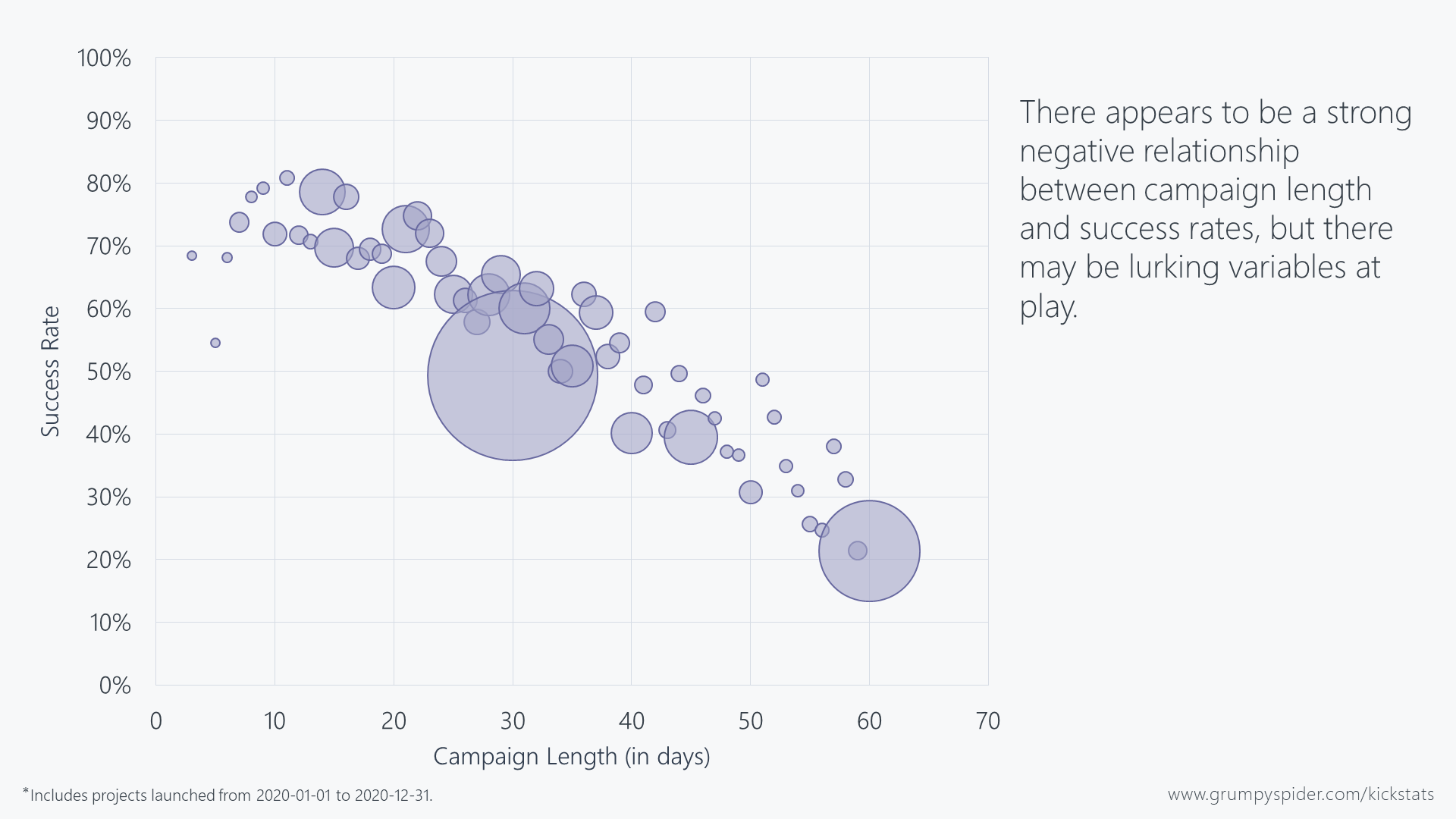
To start, let’s create a simple chart showing Kickstarter project success rates by campaign length (the size of each point represents how many campaigns share that same length).
At first glance, it looks just like what Kickstarter says: longer campaigns hurt your chances of success pretty much across the board. However, we know there may be some lurking variables that we need to account for.
First-Time Creators
We already know that first-time creators have lower success rates than their veteran counterparts. Why does that matter? Well, it may not – at least not on its own – but it could mean that there’s some confounding going on. To check for confounding, we need to show three things:
That campaign length is linked to success rates
That creator experience levels are linked to success rates
That campaign length and creator experience levels are correlated to each other
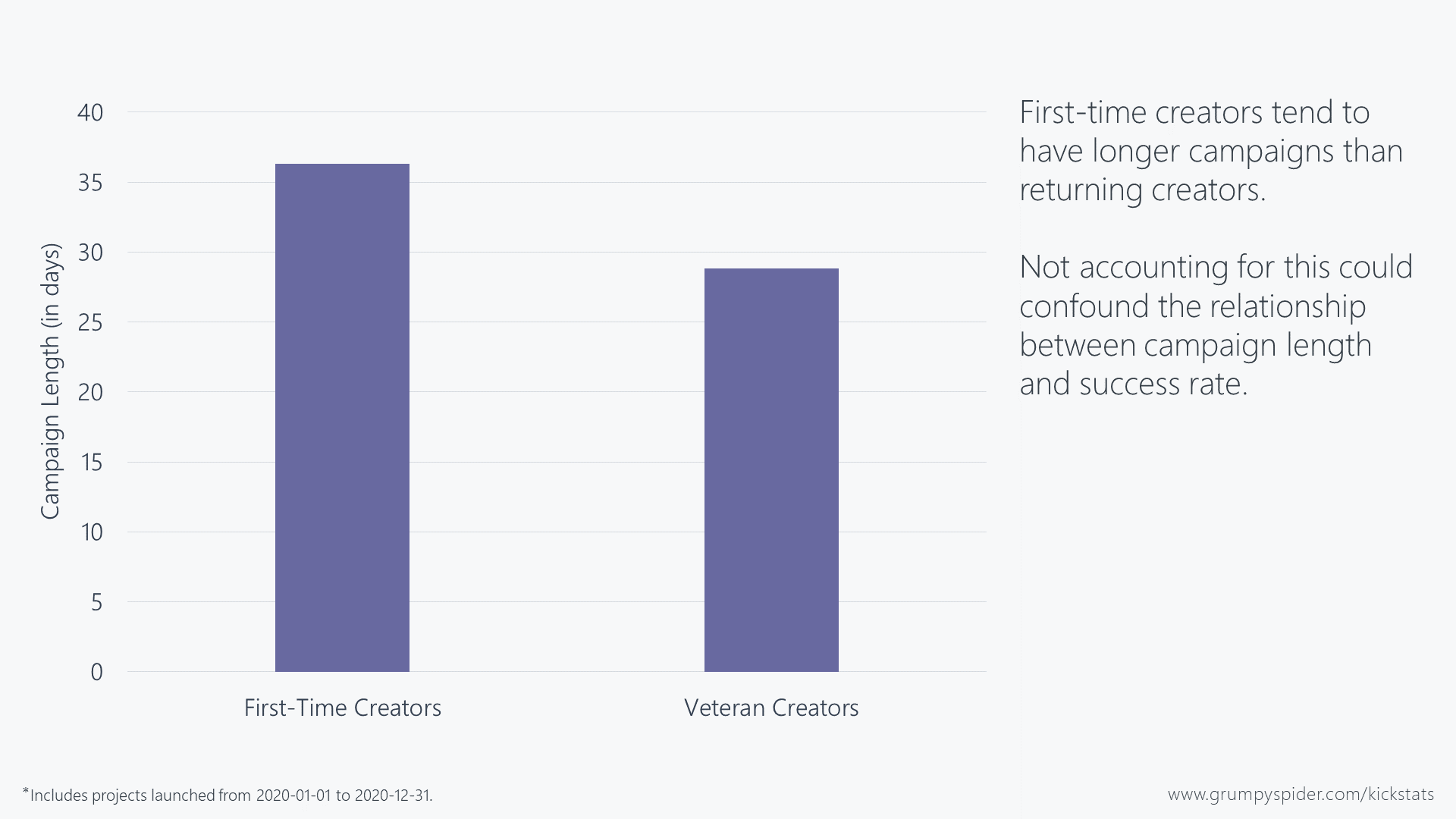
We’ve already shown the first two. If we can also show that campaign length and experience levels are related to each other, then we have a strong case for saying that they are confounding each other. So let’s graph the average campaign lengths of first-time creators vs veteran creators to see if there is any relationship.
It’s no surprise that first-time creators have longer campaigns in general. They tend to have smaller audiences, and so it’s only natural to increase the length of their Kickstarter campaigns to help make up for that.
This link between creator experience levels and campaign lengths means that we can’t say for sure what’s going on. Do shorter campaigns do better because they’re shorter, or because they tend to be run by more experienced creators? Do longer campaigns do worse because they’re longer, or because they tend to be run by less experienced creators? At this point, we just don’t know.
So how do we separate the two? How do we determine the effect that a campaign’s length has on success without it accidentally being affected by a creator’s experience level as well? We use a little statistical analysis.
I won’t go into all the details here, but essentially, what we want to do is re-weight the data based on the concentration of given variables. In this case, there are comparatively fewer first-time creators with short campaigns. So, we’ll adjust those numbers to make it seem like there are as many with shorter campaigns as there are with longer ones. In this way, we help to remove the effect that experience has on success.
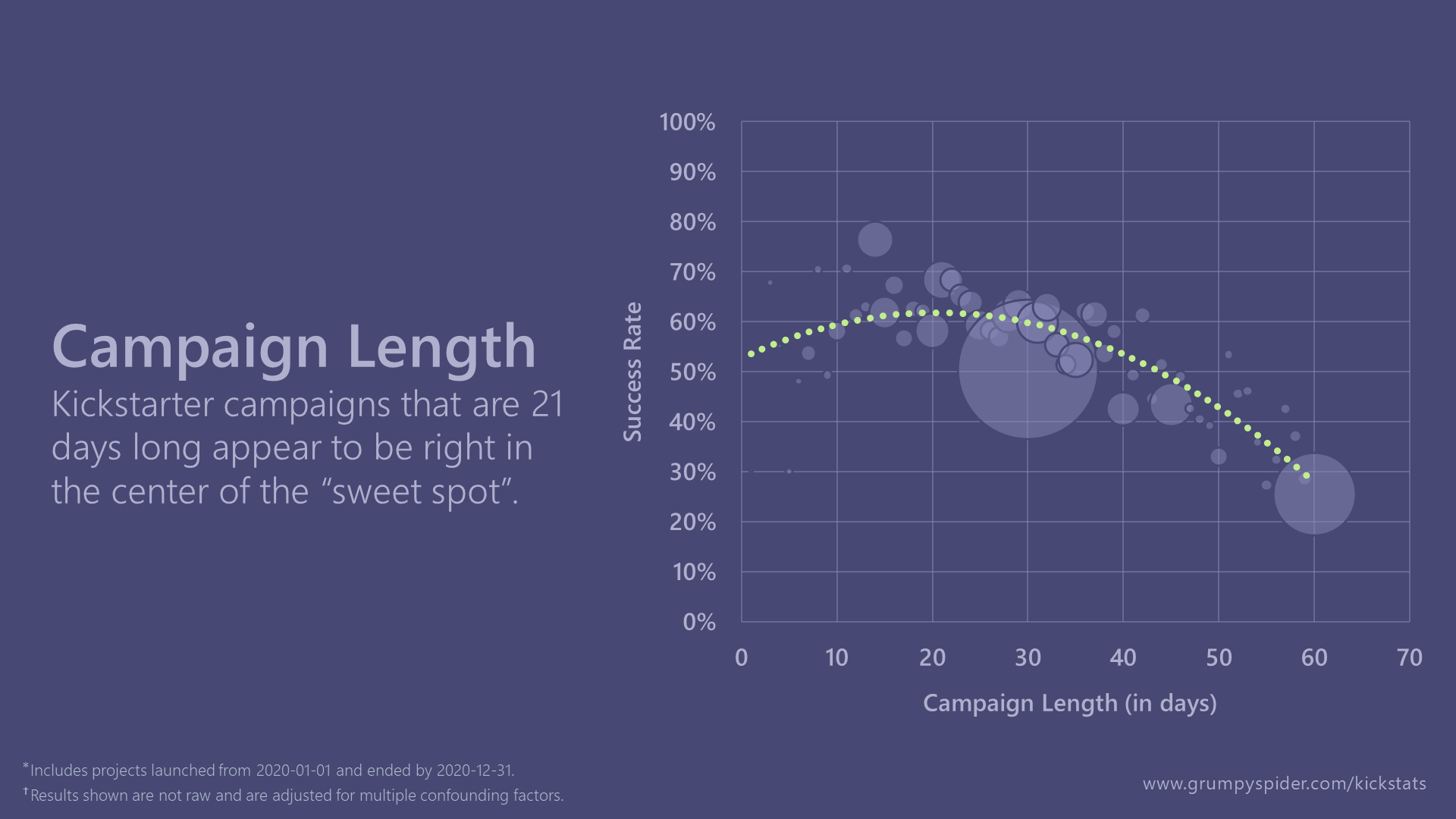
Results
After accounting for the different experience levels of Kickstarter creators, we come up with an interesting relationship between campaign length and success rates.
The negative trend is still there, but now, instead of it being clearly linear, it appears to be better explained with a curve. It seems that the higher success rate of very short campaigns – say, less than two weeks or so – is largely due to a heavy concentration of veteran creators. Once their effect was removed, we see that decreasing your campaign length isn’t always the best idea. At some point, making your campaign too short will begin to hurt you rather than help you.
I think this makes sense. Is it really reasonable to think that shortening your Kickstarter campaign will always help? If that were the case, why not make it one day long, and shoot your chances of success up to 90%?! No, what we see here is that you should shoot for the “sweet spot” – not so long that you remove urgency, but not so short that it’s finished before anyone even realizes it began.
So where is that sweet spot? Apparently somewhere around 2-4 weeks. And right in the middle of that is 21 days, which according to this analysis, is just about the best you can get.
Did you know there’s a link between a population’s life expectancy and the average number of TVs per person? It’s true. You can increase your lifespan just by getting another TV!
Now, if you have your wits about you, you may think that’s an absolutely ridiculous claim – and you’d be right! Of course buying another TV isn’t going to increase your lifespan. The reason more TVs correlates to longer life spans has nothing to do with TVs at all; it has everything to do with a particular lurking variable.
What are Lurking Variables?
Lurking variables are variables that influence your analysis, but aren’t accounted for in your study. They’re often hidden in the background and can even be completely unknown to the researcher – hence the name “lurking variable”.
In this example, the lurking variable is wealth. The more wealthy a population is, the more money it has to spend on TVs and healthcare.
That’s a silly example, I know, but it gets an important point across well. Correlation does not imply causation. Sometimes there are other factors at play that we’re just not aware of. This is one of the reasons why data analysis and statistics can be so tricky.
And that’s what I plan to do with this Kickstats blog series. I want us to get as close as we can to finding out just what exactly causes a campaign’s chance of success to increase or decrease. And hopefully we’ll have some fun along the way!
This article now includes all Kickstarter campaigns that launched in 2020. The significant increase in sample sizes has resulted in minor changes to the outcome of our original analysis. Portions of this article have been rewritten to reflect those changes.
Did you know that 66% of Kickstarter campaigns in 2020 came from first-time creators? With so many projects coming from newbies, it made me wonder how much a creator’s chance of success changes with the number of campaigns they’ve launched.
What’s my first-time chance of success on Kickstarter?
Well, that’s a difficult question to answer, since estimating chances of success for individual projects is an incredibly complex endeavor. I’d like to work up to a model that does that, but we’re not ready for that yet. For now, I can give you the overall success rate for creators who launched their very first campaign. This should at least give you an idea of what your campaign is up against.
To be honest, this actually isn’t all that surprising to me. If it’s true that Kickstarter’s success rate on the whole hovers around 51% or so, it makes sense that first-time creators would be significantly lower than that.
What this tells me is that there’s a pretty tough road ahead for creators. Success certainly isn’t guaranteed. So if your first campaign fails, just remember that you’re right there with the rest of the 61% of creators who failed their first time too.
But that leads right into the next question. What if my first project doesfail?
What if my first Kickstarter campaign failed?
What if this isn’t your first Kickstarter campaign? Maybe it’s your second… and your first one failed. Will that stain your chance of success for this one? It seems like it would, but let’s take a look at the numbers.
I’m honestly surprised at how little of an effect failure has if it’s your first time. Take at look at “0 previous campaigns, 0 previous successes”, also known as “first-time creators”. Just like we said above, the chance of success is 39%. Now take a look at “1 previous campaign, 0 previous successes”. The success rate for that cohort drops by only one point! It’s really not until you’ve failed twice in a row that it starts to drag your chances down.
Conclusion
It’s true that failing will hurt the chances of success for your next campaign, but it’s not a crazy drop, and if you can get even one success behind you, you’ll be right back in the running. Kickstarter backers tend to be very forgiving when it comes to first-time creators. Most of them realize that it can be a steep learning curve and sometimes failure is your best teacher. If you get back up, learn from your mistakes, and try again, you just may be happy you did.
So what are your thoughts? Do you have any lessons learned from failed campaigns? What do you think has helped your successful campaigns the most? Let me know in the comments!
UPDATED 2021-03-04: This article now includes all Kickstarter campaigns that launched in 2020. The significant increase in sample sizes has resulted in minor changes to the outcome of our original analysis. Portions of this article have been rewritten to reflect those changes.
It often takes a lot of data to properly analyze complex issues, and Kickstarter is no exception! But while we wait for the data to slowly pour in, I thought it would be interesting to look at the different categories Kickstarter has to offer, and how they make up the whole.
Kickstarter Categories
Kickstarter has 15 parent categories for different projects, and those parent categories break down into even more standard categories. Here’s a quick look at the top 10 based on percentage of total projects launched from January through December 2020.
That’s pretty cool, but we’re probably more interested in what categories have the highest success rates:
And Anthology Comics takes the gold, at an impressive 85.7% success rate! Board games – the largest category – is still pretty impressive though, at 71.8%, which is good to know as Grumpy Spider works toward launching our first game.
But all this got me curious – what if we looked at popularity of a category vs success? I wonder what that would look like. Thus, I present this hub & spoke chart of Kickstarter’s category hierarchies showing popularity vs success rates!
The lines show category hierarchies, the size represents the percentage of total projects that are from that category, and the brightness shows the success rate of that category. Also, in order to get a dedicated node, a category had to make up at least 7% of its parent node. Otherwise, they were lumped into their respective “Other” buckets.
The success rate of Kickstarter overall in 2020 was just over 51%, but individual categories can differ quite a bit from that, obviously. Just look at poor Technology… a relatively popular category, but really low success rates overall. I almost feel bad for Apps, which takes last place, at a measly 7% success rate.
Meanwhile, Comics seems to do the best overall, with several of their categories doing unusually well.
Conclusion
I can’t say that I have many conclusions to draw – I just thought it was interesting. But there is one important thing to keep in mind as we move forward in this series…
Be careful not to take general information and assume it always applies to specific cases. For instance, Tabletop Games as a category has a 72% success rate. Does that mean that your next tabletop campaign has a 72% chance of success? Absolutely not! Individual cases are much too complex for such simple predictions – that’s why we need lots of data, and solid methods of statistical analysis to help us find what really helps or hurts the average campaign. And that’s just what this series is all about!
If you’re like me, you’re anticipation is growing uncontrollably as you approach your Kickstarter launch! At this point, you may have started wondering what tweaks you can make to give your campaign just a little bit more of an edge. Well, that’s what this series is all about! I plan to use data from literally thousands of Kickstarter projects to find out what changes you can make to your campaign that will maximize your chance of success.
But before we dive in to all that data goodness, there’s an important point that I need stress as much as possible.
There are no shortcuts. The biggest factor to your Kickstarter’s success is the quality of your product and campaign page.
I know it may seem obvious, but it’s incredibly important to understand that the biggest factor to your success is the quality of your product and the quality of your campaign page. Preparing for and running a Kickstarter campaign takes a lot of effort, and the questions I plan to address in this blog series should not be viewed as shortcuts – because they aren’t. No amount of launching at the right time, having the right number of pledge tiers, or having the ideal campaign length will save a project that doesn’t have the necessary effort to back it up.
Every blog entry that I write from here on out will be based on this one idea. We will always start with the assumption that you have a good idea, and that you’ve put in a reasonable amount of effort toward its success. Now, I do have plans to cover a few things you can do to improve the quality of your campaign page overall, but most aspects of a page are just too difficult for me to quantify.
On a more upbeat note though, I don’t think that assumption is a very difficult one to make. The fact that you’re even reading this blog suggests you’re willing to put in the effort to help your campaign succeed.
Well, now that Grumpy Spider Games is getting ready for its first Kickstarter launch, Rucksack, I found myself asking those same questions. But the more I looked, the more disappointed I became.
I was able to find some answers, but they often weren’t quite as helpful as I had hoped. Many were based on anecdotal evidence, or just what seemed reasonable to the person answering the question. I found very few answers that were based on real numbers, and when they were, there were other aspects that limited their usefulness.
I was just about to resign myself to the dark reality of a data-less world when I came to a sudden realization. I am a statistician – as in, my day job is all about collecting, cleaning, and analyzing data. If I couldn’t find the answers I was looking for, why wasn’t I answering them myself? I mean, Kickstarter is a treasure trove of information just waiting to be mined!
So with that, I’ve decided to start “Kickstats“, a series of blog posts dedicated to answering data-centric questions about what affects the average campaign’s success rate.
What questions do you have?
I’ve got several questions that I personally want answered, but I’m sure I haven’t thought of everything. So, if you have any questions that you’re curious about, let me know in the comments, and I’ll see if I can feature them in a future post!